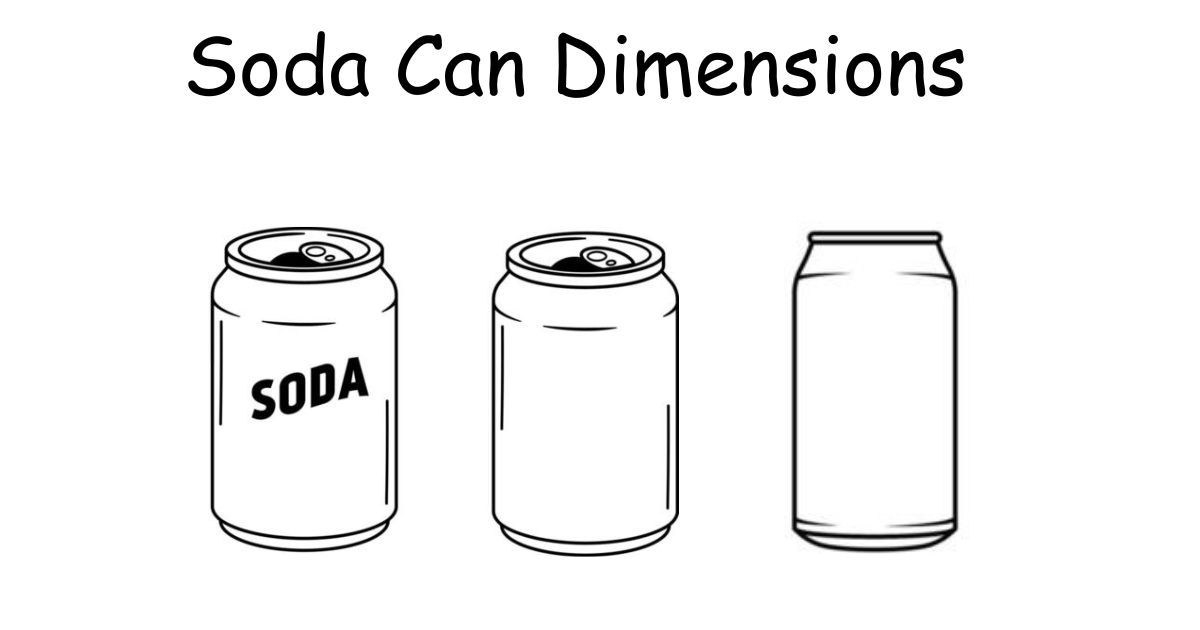
You’re mid-project and you just realized you need the exact size of a soda can. Maybe you’re cutting foam for a cooler insert. Maybe you’re designing a label wrap and guessing feels risky. Or you spotted a slim can next to a regular one and couldn’t figure out if they hold the same amount.
This is that article. No padding, no guessing.
The Can You See Every Day
Pick up a standard 12 oz Coke or Pepsi. That can is 66 mm wide and 123 mm tall — measured at the widest part of the body, seam to seam, no tab included.
In inches: 2.6 in wide, 4.83 in tall. In centimeters: 6.6 cm wide, 12.3 cm tall. Volume: 12 oz = 355 ml = roughly 1.5 cups.
The top and bottom are narrower than the middle — the lid sits at about 54 mm. That taper saves aluminum and helps the can hold pressure. A filled soda can sits at around 90 psi internally. For comparison, a car tire runs about 35 psi. The dome at the base handles that stress so the can doesn’t buckle when stacked.
Not All Cans Are Built the Same
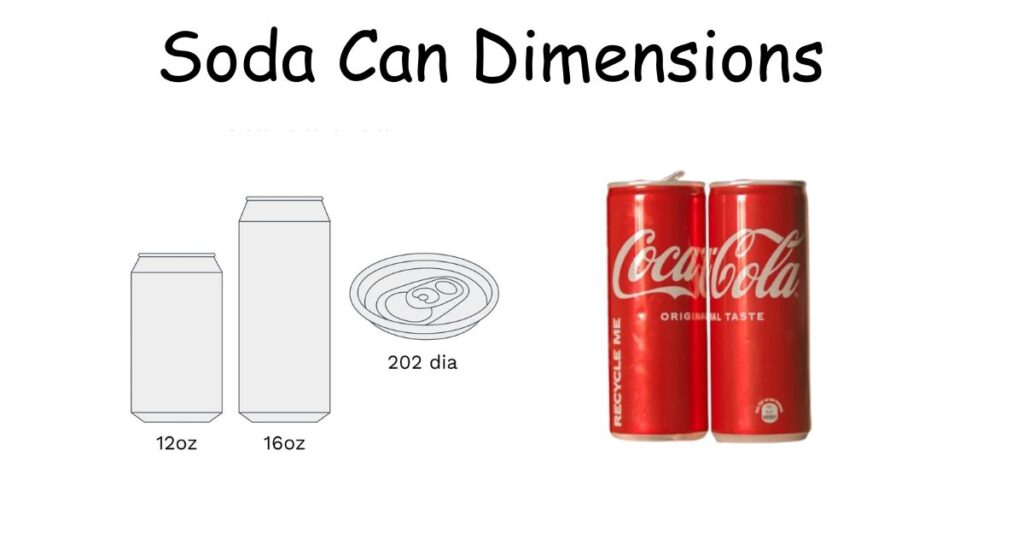
This is where most people get tripped up. There isn’t one universal soda can — there are several, and the differences aren’t always obvious from looking at them.
| Can Type | Volume | Width | Height |
| Mini | 7.5 oz / 222 ml | 54 mm / 2.13 in | 156 mm / 6.1 in |
| Standard | 12 oz / 355 ml | 66 mm / 2.6 in | 123 mm / 4.83 in |
| Slim | 12 oz / 355 ml | 53 mm / 2.1 in | 178 mm / 7 in |
| Tall Boy | 16 oz / 473 ml | 66 mm / 2.6 in | 156 mm / 6.1 in |
| Large | 24–25 oz / 710–750 ml | 66 mm / 2.6 in | 203 mm / 8 in |
Two things in that table are worth pausing on.
The mini can is actually taller than you’d expect — taller than a standard, even though it holds less. That’s because it’s narrower. The liquid has to go somewhere, so it goes up.
The slim 12 oz can holds the exact same amount as a regular 12 oz. Same volume, totally different shape. Brands use that format to look premium or to fit into tighter shelf spaces. If you’re building a holder for it, the dimensions are completely different — don’t assume same volume means same size.
The US vs UK vs Japan Problem
If you’ve ever grabbed a can of Coke abroad and thought it looked a little short, you weren’t imagining it.
US standard (355 ml): 66 mm wide, 123 mm tall UK/Europe standard (330 ml): 66 mm wide, 115 mm tall Japan slim cans (185–350 ml): around 52 mm wide, heights vary
The width is almost always the same. The height changes based on volume. That 8 mm difference between a US and UK can doesn’t sound like much, but if you’re designing a label, building a dispenser, or ordering custom packaging — it shows up fast.
Japan is its own category. Vending machines there are narrow, so ultra-slim cans dominate. You’ll also see 250 ml “kids’ cans” in Australia and parts of Asia that don’t match any standard Western size.
How to Measure One Yourself
You don’t need anything fancy — a ruler works.
Measure width at the fattest part of the can body. Not the top, not the bottom — the middle cylinder section. Measure height from the base to where the lid seam meets the body, not the tip of the tab.
A 1 mm variation is normal. Aluminum flexes slightly with temperature. Cold cans measure closer to factory specs because the metal contracts a little. If you’re making something that needs a snug fit — a 3D-printed holder, a foam cutout, a box insert — measure cold and add 1–2 mm of clearance.
Read Also: How Tall Is a Beer Can? Exact Measurements by Size
Where These Numbers Show Up in Real Life
Label design: A standard 12 oz can has about 245 mm of circumference (using the 66 mm diameter) and 123 mm of printable height on the body. Your artwork needs to wrap that cylinder without stretching at the seams.
Cooler or storage racks: Six standard cans side by side need about 396 mm of width. Slim cans pack more efficiently — useful if you’re loading a narrow backpack pocket or a tight fridge shelf.
3D printing: For a standard can holder, model a cylinder at 66 mm diameter and 123 mm height, then add 1–2 mm clearance. For slim cans, use 53 mm x 178 mm.
Bulk storage: Standard cans stack 13 x 13 per pallet layer, 8 layers high — roughly 10,800 cans per pallet. Knowing the 66 mm footprint lets you calculate shelf space fast without guessing.
DIY projects: The cut body of a standard can gives you a 12.3 cm tube that fits LED light strips snugly — which is why soda can lamp tutorials work as well as they do.
The Myths Worth Clearing Up
“Just measure the base — that’s the diameter.” No. The base is narrower than the body. Official diameter always refers to the widest point, which is the main cylinder section.
“Slim cans hold less.” The slim 12 oz holds exactly 355 ml — same as standard. Only the shape changes. The mini (7.5 oz) genuinely holds less; don’t mix those two up.
“All cans from the same brand are the same size.” Not across countries. A UK Coke can and a US Coke can have the same width but different heights. Same brand, different spec.
“The height includes the tab.” It doesn’t. Height is always measured seam to seam. The tab adds a few extra millimeters that aren’t part of the spec.
Read Also: Gatorade Bottle Sizes: Which One Do You Actually Need?
A Few Numbers Worth Memorizing
If you only take three things from this:
66 mm wide. 123 mm tall. 355 ml.
That’s the standard US can in every measurement you’d need. Everything else is a variation — narrower and taller, or same width and taller. Once you know the standard, the variations make sense.
If you’re outside the US or working with imported cans, confirm whether it’s 330 ml or 355 ml first. That single difference changes the height by 8 mm, which matters more than it sounds when fit is tight.

I am the editor and author of StoriesRadius.com, a blog about measurements and dimensions. I enjoy turning numbers and sizes into simple stories that anyone can understand. From everyday objects to curious facts, I share clear guides based on real research and experience. My goal is to make learning about length, height, and size fun, useful, and easy for all readers.