You ordered a mount. It arrived. You put it on the rail and it rocked side to side like a loose tooth. Or maybe you’re sitting at a CAD screen trying to design a custom handguard and you’ve found three different “standard” dimension charts that all disagree with each other.
That’s the real reason people search this. Not curiosity. Frustration.
The good news: there’s one authoritative spec that covers everything. Once you know those numbers, the confusion stops.
The Standard Behind the Rail
Picatinny rails are governed by MIL-STD-1913 — a U.S. military specification that locked in exact dimensions so every manufacturer builds to the same target. That’s the reason a mount made in one country drops onto a rail made in another without any fitting.
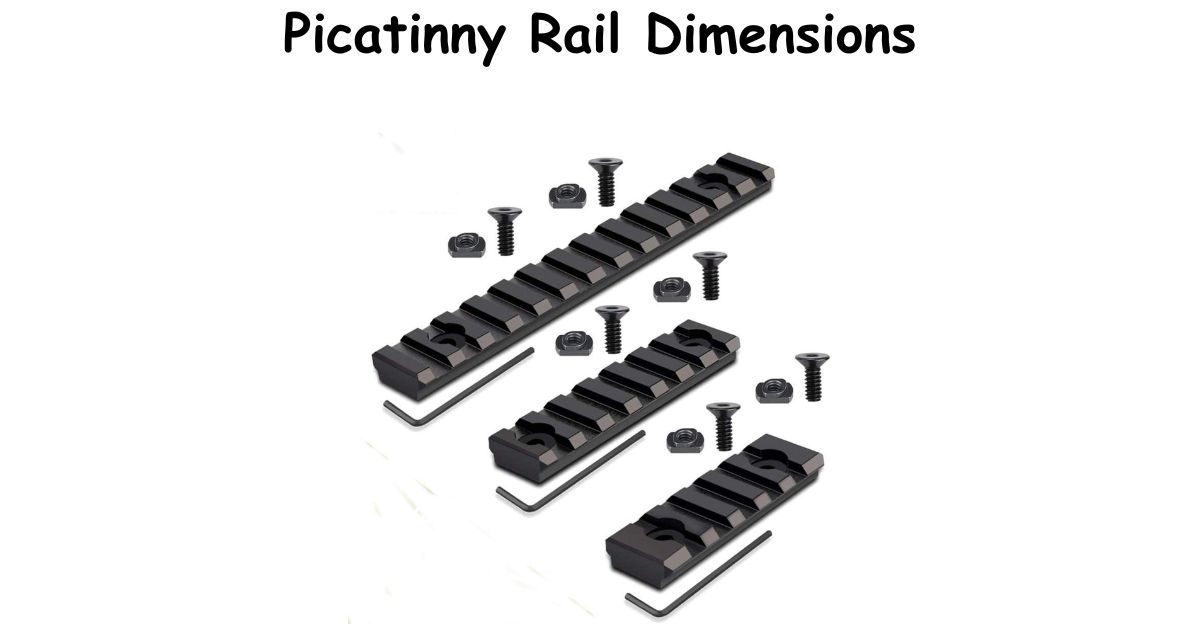
The spec covers width, slot size, slot spacing, height, and the angle of the slot walls. All of it is measurable, repeatable, and tight enough that tolerances are counted in thousandths of an inch.
The Dimensions, Straight From Spec
| Dimension | Inches | Millimeters |
| Rail Width | 0.835 in | 21.21 mm |
| Slot Width (mouth) | 0.206 in | 5.23 mm |
| Slot Spacing (center to center) | 0.394 in | 10.01 mm |
| Rail Height | 0.375 in | 9.53 mm |
| Slot Wall Angle | 45° | 45° |
| Narrowest Slot Point | 0.118 in | 3.00 mm |
Tolerances aren’t optional extras — they’re part of the spec. Width runs ±0.005 inches. Slots hold ±0.003 inches. That tightness is what makes parts from different makers snap together without slop.
One thing the table doesn’t show: the slots aren’t flat-walled rectangles. They taper inward at 45 degrees on both sides. Wide at the mouth, narrower as you go deeper. That taper is why clamps grip. When you tighten a mount, the jaws wedge into those angled walls and lock against them. Without the taper, you’d just be pinching flat surfaces — far less secure.
What “20mm Picatinny” Actually Means
Short answer: it’s not a real spec. It’s a label.
True Picatinny is 21.21 mm wide. The “20mm” description got popular through airsoft, budget imports, and lazy product listings because 20 is a round number and easier to mold cheaply. A rail built to 20 mm flat — not 21.21 — will feel slightly loose with a real Picatinny mount. Sometimes it holds fine. Sometimes the optic wanders after a few sessions.
You won’t know which until you measure. Digital calipers, not eyeballing.
Picatinny vs. Weaver — Clearing It Up Once and For All
These two look almost identical in photos. They are not the same system.
| Feature | Picatinny | Weaver |
| Slot shape | Square with 45° taper | Rounded |
| Slot spacing | Uniform — 10 mm apart | Irregular, staggered |
| Rail width | Fixed 21.21 mm | ~20 mm, varies by maker |
| Mount compatibility | Any modern tactical mount | Older scope rings mostly |
The practical result: a Weaver mount can sometimes sit on a Picatinny rail, loosely, because the Picatinny slots are a bit wider. A Picatinny mount on a Weaver rail is unreliable because the spacing doesn’t line up. Neither setup is ideal when you’re mixing the two systems.
When a product says “Picatinny compatible,” it needs to match the square slot profile and the 10 mm spacing — not just physically slide onto the rail.
Read also: Staple Sizes: Find the Right Size for Any Job Explained 2026
Slot Count by Rail Length
Slots space out every 10 mm. So rail length directly determines how many positions you have to work with.
A 5-inch rail gives you roughly 12 to 13 slots. Short handguard segments — around 55 mm — land closer to 4 or 5. Full-length top covers at 135 mm or longer can give you 20 or more positions.
Why it matters in practice: mounting a 1–6x optic toward the front of the rail for eye relief while dropping a 45-degree backup sight several slots back. That 10 mm spacing lets you calculate exactly where each accessory lands before you buy anything.
Female Picatinny — The Term That Confuses People
“Female” just means the receiving side. It’s the groove or channel cut into a receiver or handguard that accepts a rail section, rather than the rail itself.
The geometry mirrors the male rail — 21 mm wide channels, cut to about 0.375 inches deep for a flush sit. The tolerances are just as tight. On pistols with factory optics cuts, that 21.2 mm width has to be exact. Even a small amount of play in the channel causes the mounted optic to shift during use. A fraction of a millimeter becomes a real problem when it moves every time you draw.
How to Measure a Rail You Already Have
Grab digital calipers. A vernier scale works but it’s easy to misread at these tolerances.
Width across the top flat
Target: 0.835 inches. Anything outside 0.825–0.845 is out of spec.
Slot width at the mouth
Target: 0.206 inches. Above 0.220 and the mount will float. Below 0.195 and a QD lever may not engage at all.
Center-to-center spacing
Span three consecutive slots. Should total 0.788 inches across two gaps. Divide by two to confirm each sits at 0.394.
Rail height
Target: 0.375 inches from base to top. Machined rails hold this consistently. Cast or budget rails often vary slot to slot.
Slot depth
Target: 0.125 to 0.150 inches (3.2 to 3.8 mm). A slot cut 0.020 inches too shallow causes rocking that no amount of tightening fixes — common on add-on AK rails.
What Builders and Fabricators Need to Know
CNC work: use a 1/4-inch end mill for slots, plunge to 0.150 inches. The 45-degree wall angles need a separate chamfer pass — you can’t fake that geometry with a standard slot mill.
3D printing: ASA beats PLA for anything load-bearing. PLA creeps under sustained pressure and warps near heat. Print at 0.2 mm layer height, then verify post-print with a go/no-go gauge at 0.206 inches. If the plug drops in without resistance, the slot’s too wide.
For official geometry, the MIL-STD-1913 PDF is a public document. It shows T-slot end profiles, recoil shoulder height at 0.278 inches, and slot-end fillet radii at R0.03 inches. For CNC import, DXF vector files with full tolerances are available through machining communities and save a lot of manual dimensioning.
STANAG 4694 — the NATO metric equivalent — aligns closely with 21 mm width and the same slot spacing. Practically interchangeable for most builds, though the tolerance band differs slightly.
The Mistakes That Cause Real Problems
Overtightening. Aluminum rails strip between 40 and 50 inch-pounds. Torque mounts to 20–30 and stop. A torque wrench isn’t optional if your zero matters.
Slots measuring 5.5 mm instead of 5.23 mm. This is the most common quality failure on budget rails. The mount seats, looks fine, and then walks forward under recoil because the clamp never had proper wall contact.
Slots measuring under 4.9 mm. QD levers physically can’t open inside them. You force it, something bends, and now nothing fits right.
Shallow slot depth on cast rails. Specifically on aftermarket AK mounts. Depth under 3 mm looks fine visually but wobbles under any lateral load.
Trusting “Picatinny compatible” without checking. That phrase has no enforcement behind it. Measure first if the source is unknown.
Read also: Ammo Can Sizes: A Real Buyer’s Guide That Skips the Fluff
Direct Answers to Real Questions
What width is a Picatinny rail in metric?
21.21 mm. Not 20, not 22. If a product says 20 mm Picatinny, measure it before relying on it.
Can Weaver mounts work on Picatinny rails?
Sometimes, loosely. Don’t count on it holding zero under recoil.
Where do I find official dimension drawings?
Search “MIL-STD-1913 PDF” — it’s public. For CNC work, find a DXF version with tolerances already built in.
Is STANAG 4694 the same as Picatinny?
Close enough for most builds. Width is 21 mm vs 21.21 mm. Slot spacing is identical.
How deep should the slots be?
3.2 to 3.8 mm (0.125 to 0.150 inches). Shallower than that and clamps won’t engage fully.
The Part Most People Miss
Everyone focuses on rail width. Width matters, but slot depth is what actually controls whether a mount locks or wobbles. A rail can be exactly 21.21 mm wide and still fail if the slots are cut 0.020 inches too shallow.
If you’re buying a rail for anything that needs to hold zero — optic, laser, anything you’ll trust — check slot depth with calipers before mounting. It takes 30 seconds and it’s the one measurement that separates a solid build from one that shifts on the third shot. Three numbers run the whole system: 21.21 mm wide, 5.23 mm slot mouth, 10 mm spacing. Get those right and everything else follows.

I am the editor and author of StoriesRadius.com, a blog about measurements and dimensions. I enjoy turning numbers and sizes into simple stories that anyone can understand. From everyday objects to curious facts, I share clear guides based on real research and experience. My goal is to make learning about length, height, and size fun, useful, and easy for all readers.