You’ve got a mattress picked out. Maybe it’s already on its way. Then someone mentions a box spring and suddenly you’re down a rabbit hole of twin XLs, split kings, low-profile options, and centimeter conversions. What seemed like a five-minute decision is now a half-hour of confusion.
Here’s the thing — box spring sizing isn’t complicated once someone explains it honestly. That’s what this is.
The Basic Rule (And Why It’s Almost Too Simple)
Your box spring size matches your mattress size. Queen mattress, queen box spring. King mattress, king box spring. That part really is straightforward.
What trips people up is everything else — the height, whether to split it, what works with which mattress type, and how to measure for a room that might not cooperate. Those details matter more than the length and width numbers.
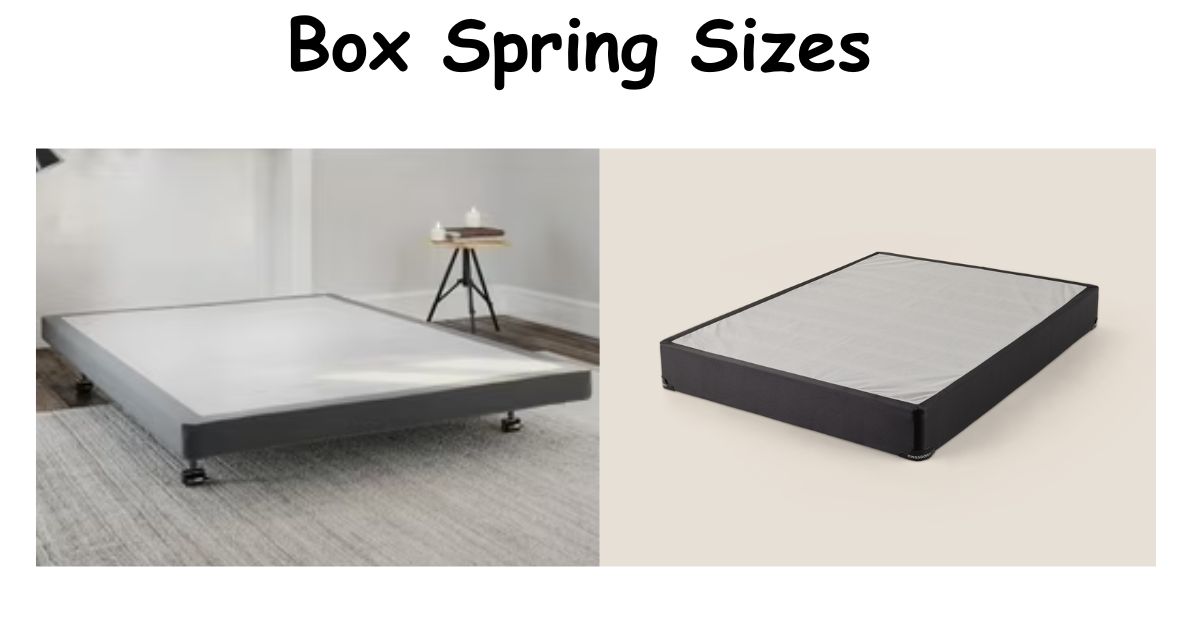
A box spring is essentially a supportive base — a fabric-covered frame of wood or metal — that sits between your bed frame and your mattress. Most people picture springs inside. That used to be true. Today, most are just slatted wooden foundations with a fabric wrap. The name outlasted the actual springs.
The Sizes, Laid Out Clearly
All standard box springs follow U.S. mattress dimensions. Here’s the full picture:
| Size | Width × Length (inches) | In Centimeters |
| Twin | 38 × 75 | 97 × 191 cm |
| Twin XL | 38 × 80 | 97 × 203 cm |
| Full | 54 × 75 | 137 × 191 cm |
| Full XL | 54 × 80 | 137 × 203 cm |
| Queen | 60 × 80 | 152 × 203 cm |
| Olympic Queen | 66 × 80 | 168 × 203 cm |
| King | 76 × 80 | 193 × 203 cm |
| California King | 72 × 84 | 183 × 213 cm |
For oversized or custom beds — Wyoming King (84 × 84), Texas King (80 × 98), Alaskan King (108 × 108) — box springs exist but are custom-built. You won’t find these at a regular furniture store.
One thing people miss: measure your mattress edge to edge, not just read the tag. Tags can run 1–2 inches off. A 54-inch full on a 60-inch queen frame doesn’t sit flush — it shifts and wobbles over time.
Read also: King Size Pillow Dimensions: The Real Answer You’re Looking For
Height Is the Decision People Underestimate
Width and length are fixed by your mattress. Height is where you actually have a choice — and where most people don’t think carefully enough.
Standard height sits around 8–9 inches. Works well with thinner mattresses. If your mattress is 10 inches thick, a standard box spring brings the total sleeping surface to roughly 19–20 inches. That’s comfortable for most adults without feeling like you’re climbing into bed.
Low-profile runs 4–6 inches. This is the right call when your mattress is thick — 12 inches or more. A 14-inch pillow-top plus a 9-inch box spring puts you at 23 inches before even counting the frame. Pair that same mattress with a 5-inch low-profile and you’re at 19 inches. Much more manageable.
Ultra-low options (1–3 inches) are basically flat boards. These show up in RV setups, platform frames, or situations where ceiling clearance is actually a concern.
The practical test: add your mattress height to your planned box spring height. Aim for a total sleeping surface between 18 and 23 inches. Below 18 feels low. Above 24 starts to feel like you need a running start.
Split Box Springs — When They’re Worth It and When They’re Not
A split box spring divides one large unit into two smaller pieces. Same total footprint, but manageable sections instead of one awkward slab.
King split: Two Twin XL pieces, each 38 × 80 inches. Together they equal a full 76 × 80 king. This is the most practical option for anyone with a tight staircase or a hallway that doesn’t have generous clearance. Moving a single 76-inch-wide box spring around corners is genuinely miserable. Two 38-inch pieces aren’t.
Queen split: Two pieces at 30 × 80 inches each. Less common than king splits but useful in the same situations. Queen splits sometimes cost more than a single queen unit — worth checking both prices before deciding.
California King split: Two pieces at 36 × 84 inches. Same logic applies. The extra length of a Cal king already makes navigation harder, so splits are worth serious consideration.
Splits also make sense for couples using adjustable bases. Each side moves independently. One person sitting up at midnight reading, the other flat — no mechanical conflict between the two halves.
They’re not always cheaper, though. Factor that in before assuming splits save money.
Which Mattress Types Actually Need a Box Spring
This is where people spend money they don’t need to spend — or skip something they actually do need.
Innerspring mattresses pair well with box springs. The coil systems work together, airflow stays good underneath, and the mattress wears more evenly over time.
Memory foam doesn’t belong on a traditional coiled box spring. Uneven contact points cause the foam to develop soft spots. A solid platform or a slatted base with slats no more than 3 inches apart does the job better.
Hybrid mattresses vary. Some work fine on box springs. Others need solid support. Check your specific mattress warranty — it usually spells out what counts as “proper support,” and using the wrong base can void that coverage.
Latex mattresses are dense and heavy. Solid, even support is what they need. Skip the box spring and go with a firm foundation.
If the warranty documentation uses the phrase “proper support required,” don’t guess. Contact the manufacturer directly and ask what qualifies. Two minutes on the phone can save a lot of hassle later.
Size in Feet — For Room Planning
Some people find feet easier when mapping out a bedroom. Here’s a quick conversion for the most common sizes:
- Twin: roughly 3.2 × 6.3 feet
- Full: roughly 4.5 × 6.3 feet
- Queen: roughly 5 × 6.7 feet
- King: roughly 6.3 × 6.7 feet
- California King: roughly 6 × 7 feet
A queen needs at minimum a 10 × 10-foot room to not feel cramped — and that’s without nightstands. 10 × 12 is more realistic for a livable setup. Twins work in 7 × 9-foot spaces. Kings really want a 12 × 12 to breathe properly.
Measure your room before buying, not after. And leave at least 24 inches on the sides of the bed if you can. Less than that and the room starts to feel like an obstacle course.
What People Get Wrong (Consistently)
Buying based on the frame, not the mattress. The frame’s labeled size isn’t always accurate. Measure the mattress itself.
Not accounting for total bed height. A thick mattress plus a standard box spring can push the sleeping surface to 27–28 inches. That’s not a safety issue, but it’s uncomfortable — especially for shorter people or anyone with hip and knee concerns.
Putting memory foam on the wrong base. Feels fine at first. A few months later, soft spots appear where contact was inconsistent. By that point, return windows have closed.
Assuming splits are always cheaper. They’re often not. Sometimes significantly more expensive for queen and California king splits. Always compare prices both ways.
If You’re Thinking About Skipping the Box Spring
Completely reasonable depending on your setup.
A platform frame handles most mattress types without adding significant height. Prices generally run $50–200. Slatted platforms work well for memory foam as long as slats are close together.
Bunkie boards — those flat 2-inch panels — solve the “slats too far apart” problem without adding real height. Usually under $50. Worth knowing about if you’ve got a platform frame with gaps that are too wide.
Adjustable bases cost more but offer real utility: elevation for reading, positioning for back support, independent sides for couples. They pair naturally with split configurations.
And if your mattress is a hybrid with built-in coils, you may not need any base beyond a solid platform. That’s $100–300 you just didn’t spend.
Read also: Tacoma Bed Dimensions: Every Generation’s Real Numbers and What Actually Fits
Questions People Actually Ask
Can two Twin XL box springs work as a king?
Yes. Two 38-inch-wide Twin XLs placed side by side equal 76 inches — the exact width of a standard king — and both are 80 inches long. This is the most practical king split option because Twin XLs are easy to find and usually priced reasonably.
What’s an Olympic Queen and do I need one?
An Olympic Queen box spring is 66 × 80 inches — 6 inches wider than a standard queen. It exists for Olympic Queen mattresses, which are specialty items. Unless your mattress specifically says Olympic Queen, you don’t need it.
How do I convert box spring sizes to centimeters?
Multiply any inch measurement by 2.54. A queen (60 × 80 inches) becomes 152 × 203 cm. A king (76 × 80 inches) becomes 193 × 203 cm. A California king (72 × 84 inches) becomes 183 × 213 cm.
Does box spring height affect anything besides how the bed looks?
Yes. It directly affects how easy it is to get in and out of bed, how your mattress wears over time, and whether your total bed height is physically comfortable for your body. It’s not aesthetic — it’s functional.
Is a Full XL worth it over a regular Full?
If you’re over 5’10”, probably yes. The Full XL adds 5 inches of length (54 × 80 vs. 54 × 75). Same width, just longer. For a guest room where you don’t know who’ll be sleeping there, Full XL is the safer bet.
Before You Buy — The Short Version
Pick your size to match your mattress, not your frame. Measure the mattress itself.
Decide on height based on your mattress thickness — aim for a total sleeping surface around 18–23 inches. Choose low-profile if your mattress is 12 inches or thicker.
Consider a split if you have stairs, tight hallways, or an adjustable base situation. Confirm your mattress type actually benefits from a box spring before buying one at all.
That’s genuinely it. The rest is just color options and price differences.

I am the editor and author of StoriesRadius.com, a blog about measurements and dimensions. I enjoy turning numbers and sizes into simple stories that anyone can understand. From everyday objects to curious facts, I share clear guides based on real research and experience. My goal is to make learning about length, height, and size fun, useful, and easy for all readers.