You’re holding a small screw, squinting at it, trying to figure out if it’s the right one. Or you’re about to order online and you keep seeing “M4” without really knowing what that means for your project. Maybe you stripped one and need an exact match. Maybe you’re designing something and need real numbers, not vague descriptions.
This is that guide.
The “M4” Label Decoded
M4 is not a product name or a brand code. It’s a measurement. The “M” means metric. The “4” is the thread diameter — 4 millimeters, measured across the widest part of the threaded shaft.
That’s the whole thing.
So M4×16 means: metric thread, 4 mm wide, 16 mm long. Once that clicks, every metric screw label makes sense.
In inches? 4 mm is about 0.157″. That puts it physically between a #6 and #8 imperial screw — but don’t try to swap them. The thread angles and pitches are completely different systems.
Thread Pitch: The Detail Most People Skip
Every M4 screw has a pitch — the distance between thread ridges. Two versions exist:
M4×0.7 is the coarse pitch. Threads are spaced 0.7 mm apart. This is the standard version. It’s what you’ll find in every hardware store, what most machinery uses, and what most threaded holes are cut for.
M4×0.5 is the fine pitch. Tighter threads, better grip in thin material, more vibration resistance. Used in precision instruments, adjustment mechanisms, and thin sheet assemblies. Harder to find. Easier to cross-thread if you’re rushing.
If no pitch is written on the packaging or drawing, assume coarse (0.7 mm). That’s almost always correct.
How Long Should Your M4 Screw Be?
Length is the dimension most people guess wrong. Here’s a simple principle worth remembering:
The screw needs at least 6 mm of thread inside the material it’s gripping — that’s 1.5× the 4 mm diameter, which is the minimum for a solid hold.
If you’re going through a 4 mm panel into something behind it, an M4×16 gives you roughly 12 mm of thread engagement after passing through. That’s solid.
| Length Range | Typical Application |
| 8–12 mm | Electronics enclosures, PCB mounts, small fittings |
| 16–20 mm | Light brackets, sheet metal frames, furniture pieces |
| 25–40 mm | Thicker assemblies, panel stacking, structural builds |
| 50 mm+ | Custom or deep through-hole work |
Short screws in thick material = weak grip. Long screws in thin material = screw bottoms out before clamping. Neither works well.
Head Types: This Is Where the Real Decisions Happen
The M4 thread is fixed. But head type changes the shape, the tool you need, how the screw sits on the surface, and whether it’ll even fit in your space. This section is worth reading carefully.
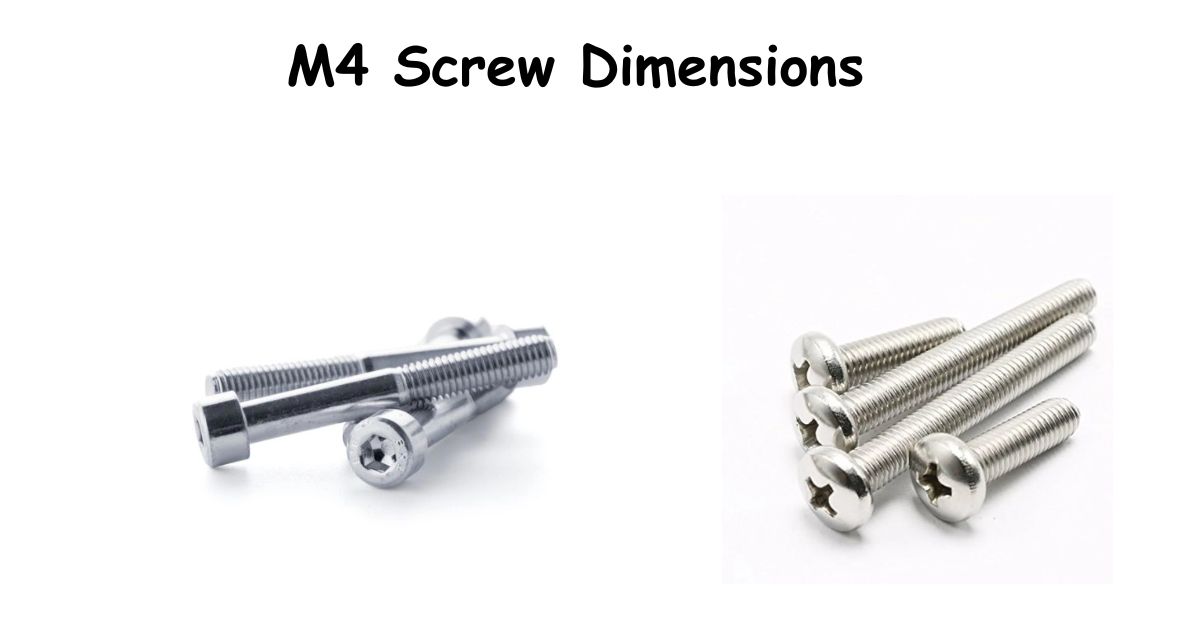
Socket Head Cap
Tall cylindrical head. The go-to for machinery, robotics, 3D printers, and any build where you’re using Allen keys.
- Head diameter: 7.22 mm
- Head height: 4.0 mm
- Drive: 3 mm hex key
Strong, compact footprint, high clamping force. The taller head means it sticks up more — worth checking if clearance is tight.
Button Head Socket
Low dome, clean look. Popular in electronics enclosures and modern builds where appearance matters.
- Head diameter: 7.60 mm
- Head height: 2.20 mm
- Drive: 2.5 mm hex key
The shallow drive limits how much torque you can apply. Fine for light assemblies. Not ideal for joints that need serious clamping.
Low Head Socket Cap
Basically a flatter socket head cap for tight-clearance situations.
- Head diameter: 7.0 mm
- Head height: 2.8 mm
- Drive: 2.5 mm hex key
Use this when a standard socket cap is too tall and a button head isn’t strong enough.
Pan Head Phillips
Wide, slightly rounded top. Sits proud of the surface. Common in consumer products, plastic housings, and furniture.
- Head diameter: ~8.0 mm
- Head height: ~3.25 mm
- Drive: Phillips #2
The wider head distributes load well. Easy to drive with a standard screwdriver. Not the strongest drive type, but reliable for everyday assemblies.
Countersunk / Flat Head Phillips
Tapered head designed to sit flush with — or below — the surface.
- Head diameter: ~8.96 mm
- Head height: ~2.48 mm
- Drive: Phillips #2
Requires a matching countersunk hole. If you just drill a straight hole and use this head, it won’t sit flush — it’ll rock. Common in panels, covers, and anywhere a protruding head would be a problem.
Hex Bolt Head
Six flat sides. Driven with a wrench, not an Allen key.
- Head width across flats: 7 mm
- Head height: ~2.9 mm
- Drive: 7 mm wrench or socket
Used when torque needs to be high, or when a wrench is easier to reach into the space than a hex key. Structural brackets, motor mounts.
Read also: Staple Sizes: Find the Right Size for Any Job Explained 2026
Full Head Dimensions at a Glance
| Head Type | Head Diameter | Head Height | Drive |
| Socket head cap (DIN 912) | 7.22 mm | 4.0 mm | 3 mm hex key |
| Button head (ISO 7380) | 7.60 mm | 2.20 mm | 2.5 mm hex key |
| Low head socket cap | 7.0 mm | 2.8 mm | 2.5 mm hex key |
| Hex bolt (DIN 933) | 7.66 mm | 2.93 mm | 7 mm wrench |
| Pan head Phillips (DIN 7985) | 8.0 mm | 3.25 mm | Phillips #2 |
| Countersunk head (DIN 7991) | 8.96 mm | 2.48 mm | Phillips #2 |
Drill Bit Sizes for M4
Two different hole types, two different drill sizes. People mix these up constantly.
Clearance hole — the screw passes straight through. No threading into the wall. Use a 4.3 to 4.5 mm drill bit. The screw slides freely without biting into the sides.
Tapped hole — threads cut directly into the material. Drill 3.3 to 3.4 mm first, then cut M4×0.7 threads with a tap. The threads grip the shaft. Too wide and threads strip out. Too narrow and you’ll snap the tap.
This step matters more than most beginners expect. Wrong hole size is usually what causes a “bad thread” — not the screw.
Nuts and Washers That Match M4
An M4 hex nut (ISO 4032) has a width of 7 mm across the flats and sits about 3.2 to 3.5 mm tall. It threads onto the same M4×0.7 pitch, so they match straight out of the box — as long as you’re buying standard coarse-pitch hardware.
M4 washers have an inner hole of about 4.3 mm. Use them when screwing into plastic, soft aluminum, or any surface where the head might sink under load. The washer spreads the clamping pressure across more surface area and prevents pull-through over time.
M4 vs. M3 and M5: Choosing Between Sizes
| Size | Thread Diameter | Sweet Spot |
| M3 | 3 mm | PCBs, small electronics, featherweight brackets |
| M4 | 4 mm | General builds, light frames, sheet metal, standoffs |
| M5 | 5 mm | Heavier loads, thick plates, structural joints |
M4 handles most light-to-moderate work without being oversized. Thin sheet metal panels, control box mounting, fan brackets — all solid M4 territory. If the load is heavy or the material is thick (8 mm+ steel), M5 or M6 starts making more sense. The shear and tensile limits of M4 are real, even if they’re rarely a problem in everyday builds.
Mistakes That Actually Happen
Using the wrong hex key size. Socket head caps take 3 mm. Button heads and low-profile heads take 2.5 mm. Using the next size up — even by a half millimeter — rounds out the recess. Once that happens, the screw is nearly impossible to remove cleanly.
Threading into plastic without a pilot hole. Forcing an M4 into plastic without drilling first cracks the material or creates weak threads that strip on the second assembly. Drill 3.3 mm first, even in plastic.
Assuming M4 fine pitch and coarse pitch are interchangeable. They look identical. They’re not. An M4×0.5 screw won’t thread properly into an M4×0.7 tapped hole. If it feels wrong going in, stop — you’re cross-threading.
Buying imperial “close enough.” A #8 screw is 4.17 mm — looks similar, completely different thread. It won’t fit an M4 nut or tapped hole.
Read also: Picatinny Rail Dimensions: The Numbers That Actually Make or Break Your Build
Metric vs. Inches: Quick Conversion Reference
| M4 Dimension | Metric | Inches (approx.) |
| Thread diameter | 4.0 mm | 0.157 in |
| Coarse pitch | 0.7 mm | 0.028 in |
| Fine pitch | 0.5 mm | 0.020 in |
| Nut width | 7.0 mm | 0.276 in |
| Clearance drill | 4.3–4.5 mm | 0.169–0.177 in |
| Tap drill | 3.3–3.4 mm | 0.130–0.134 in |
Questions Worth Answering Directly
What hex key fits an M4 socket head cap screw?
3 mm. Not 2.5, not 4. Specifically 3 mm for the standard socket head cap. Button head and low-profile versions use 2.5 mm.
Can M4 screws be used in plastic?
Yes, with care. Coarse pitch works better than fine in plastic. Drill a pilot hole first. Don’t overtighten — snug plus a small quarter turn is enough. For parts you’ll disassemble repeatedly, press-in brass inserts hold much better than threading directly into the plastic.
Is M4 the same as a #8 screw?
Close in diameter but not interchangeable. Thread pitch, angle, and fit are all different. They won’t work in each other’s holes.
What torque for M4?
Grade 8.8 steel: around 2.5–3.0 Nm. In plastic or soft material, 0.5–1.0 Nm is safer. No torque wrench? Snug plus a gentle quarter turn is a reasonable manual approach for non-critical joints.
What does M4×0.7 mean exactly?
M = metric. 4 = 4 mm thread diameter. 0.7 = 0.7 mm pitch (distance between thread crests). It’s a complete description of the thread geometry in five characters.
What to Focus On
The thread diameter is set — 4 mm, that’s M4. After that, three things actually determine whether the screw works for your project:
Length — enough thread engagement (minimum 6 mm) into the gripped material.
Head type — matched to your tool, your clearance, and whether the surface needs to be flush.
Hole size — clearance at 4.3–4.5 mm, tapped at 3.3–3.4 mm. Get this right before you start threading anything.
Everything else — grade, finish, stainless vs. carbon steel — matters for specific environments (outdoor, high load, corrosion risk). For most everyday builds, a standard M4×0.7 in grade 8.8 zinc-plated steel covers 90% of situations.
Pick the right length. Pick the right head. Drill the right hole. That’s the whole job.

I am the editor and author of StoriesRadius.com, a blog about measurements and dimensions. I enjoy turning numbers and sizes into simple stories that anyone can understand. From everyday objects to curious facts, I share clear guides based on real research and experience. My goal is to make learning about length, height, and size fun, useful, and easy for all readers.