You pulled out a card you haven’t seen in years. Maybe it’s a rookie card from the early 90s. Maybe it’s something you just picked up at a flea market for two dollars. Now you’re wondering — does this fit in a standard sleeve? Can I frame it? If I wanted to make one just like it, what would the dimensions be?
Good news. This is one of those topics that looks complicated but really isn’t once someone breaks it down plainly.
The Number You Actually Need
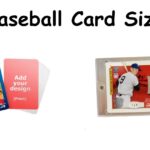
Standard baseball card: 2.5 inches wide, 3.5 inches tall.
That’s the size. Has been since Topps locked it in around 1951. Every major brand — Topps, Upper Deck, Panini — follows it today. Every sleeve, binder page, and top loader at your local hobby shop is built around this exact measurement.
If that’s all you needed, you’re good to go. If you want the full picture, keep reading.
The Same Size, Different Units
Depending on what you’re doing — ordering frames online, designing in Photoshop, shipping internationally — you might need this in different formats.
| Format | Width | Height |
| Inches | 2.5 in | 3.5 in |
| Millimeters | 63.5 mm | 88.9 mm |
| Centimeters | 6.35 cm | 8.89 cm |
| Pixels at 300 DPI | 750 px | 1050 px |
| Pixels at 72 DPI | ~186 px | ~260 px |
The 300 DPI pixel count is for printing. The 72 DPI version is screen-only — fine for a digital preview, but it’ll print soft and blurry if you try to use it on paper.
Read also: What Size Is a Birthday Card? (Inches, cm, mm & Pixels Explained) 2026
When the Size Changes
Most cards you encounter are standard. But there are real exceptions, and they matter when you’re buying storage or designing something custom.
Mini cards show up as inserts inside packs. They’re 1.5 x 2.5 inches — noticeably smaller. Fun to collect, but they need different sleeves.
Oversized cards come in premium sets, autograph editions, or box toppers. The most common oversized formats are 3 x 5 and 5 x 7 inches. These don’t fit standard pages at all.
Photo-style cards — sometimes called memorabilia hybrids — are often 4 x 6 inches, closer to a standard photo than a card.
Quick reference:
| Card Type | Inches | Millimeters |
| Standard | 2.5 x 3.5 | 63.5 x 88.9 |
| Mini | 1.5 x 2.5 | 38.1 x 63.5 |
| Oversized | 3 x 5 | 76.2 x 127 |
| Jumbo | 5 x 7 | 127 x 178 |
| Photo-style | 4 x 6 | 102 x 152 |
Vintage cards from before the 1950s — especially old tobacco cards — were often hand-cut and don’t match any of these cleanly. If you’ve got something that old, measure it before assuming anything.
Designing a Custom Card
Open Canva, Photoshop, Illustrator — doesn’t matter. Set your canvas to 750 x 1050 pixels at 300 DPI. That’s your working space.
A few things that trip people up:
Starting at 72 DPI is the most common mistake. The design looks perfectly fine on screen. Then it prints looking like a screenshot from 2003. Always start at 300.
Add a 0.125-inch bleed on all four sides if you’re sending the file to a print shop. That tiny border gets cut off during trimming. Without it, even a slightly off cut leaves a white sliver on one edge — and it always shows.
Some templates online list 822 x 1122 pixels instead of 750 x 1050. Both are correct — the difference comes from how the software handles bleed. Pick one and stay consistent throughout your project.
For cardstock, 16 pt gloss is the closest feel to a real card. Home printers work fine for prototypes. For a final version that actually looks like a card, a dedicated print service gives much better results.
Thickness — The Part Nobody Talks About
Width and height get all the attention. Thickness matters too, especially for storage.
Standard cards are roughly 0.25 to 0.35 mm thick — that’s about 14 to 20 pt cardstock. Flexible enough to bend slightly, firm enough to handle normally.
Relic cards, patch cards, and thick refractors can hit 0.5 mm or more. A regular top loader won’t close properly on those. You need top loaders specifically rated for thick cards — usually labeled 100pt or 130pt on the packaging.
Check the label before buying. “Standard” top loaders are made for standard-thickness cards. Getting the wrong ones means either a card that rattles around loosely or one that won’t go in at all.
Baseball Cards and Other Trading Cards

Here’s something that surprises a lot of people: baseball cards share their exact dimensions with almost every other major card game and sport.
| Card Type | Size (Inches) |
| Baseball | 2.5 x 3.5 |
| Basketball | 2.5 x 3.5 |
| Football | 2.5 x 3.5 |
| Pokémon TCG | 2.5 x 3.5 |
| Magic: The Gathering | 2.5 x 3.5 |
One box of sleeves covers all of them. One binder works for a mixed collection. It’s genuinely convenient.
The exception worth knowing: some European soccer cards use approximately 60 x 80 mm — slightly smaller than the 63.5 x 88.9 mm standard. Not all of them, but enough that it’s worth checking before you buy storage for those specifically.
Read also: Flashcard Sizes: The Practical Guide Nobody Actually Writes
Storage Options and What Each One Does
Penny sleeves — thin soft plastic that slides over the card. Protects against fingerprints and light scratches. Good for cards you handle regularly or store in binders. Not enough protection on their own for anything valuable.
Top loaders — rigid plastic holders. This is what you use for cards you actually care about. They prevent bending and are sturdy enough to mail safely. Standard ones fit cards up to about 20 pt thickness. Thicker cards need a thicker top loader.
9-pocket binder pages — hold 9 cards per page, fit standard 3-ring binders. A filled binder with 81 pages holds 729 cards. Good for sets you want to flip through and organize.
Graded slabs — when a card gets professionally graded by PSA or BGS, it gets sealed in a rigid plastic case. These add roughly 3 mm to each side of the card. Keep that in mind when building a display case or trying to fit slabs into a storage box.
One thing to avoid: rubber bands around card stacks. It seems harmless. Over time, the pressure causes corner dings and surface impressions. Sleeves first, then stack, then store flat.
A Little History Behind the Size
Before 1951, card sizes were all over the place. The earliest collectible cards came tucked inside cigarette packs in the late 1800s — typically around 1.5 x 2.5 inches, which is basically today’s mini size. Candy companies made their own versions too, each with slightly different cuts.
Topps picked 2.5 x 3.5 when they launched their flagship set and it stuck. Not because of any deep reason — it was a practical size that fit well in hands, printed cleanly, and stored neatly. Everyone else followed. Seventy-plus years later, nothing has changed.
Modern production cuts cards with die-cutting machines accurate to a fraction of a millimeter. Grading services like PSA take that seriously — a card that’s even slightly trimmed can drop an entire grade, which in the high-end market can mean a significant drop in value.
Real Questions People Ask
Do standard sleeves fit Pokémon cards?
Yes. Pokémon cards are 2.5 x 3.5 inches, same as baseball cards. The sleeves are completely interchangeable.
What pixels should I use for a baseball card template?
750 x 1050 at 300 DPI for print. Add 0.125-inch bleed if printing professionally.
Can I frame a baseball card in a regular photo frame?
A 4×6 or 5×7 photo frame is too big without a custom mat. Trading card display frames exist specifically for this — they hold the card snugly at 2.5 x 3.5. Shadow boxes work well too, and a 12 x 12 inch one can hold around 20 standard cards laid flat.
Are Topps cards a different size from other brands?
No. Topps follows the standard exactly — 2.5 x 3.5 inches across all their sets including Chrome and refractors.
What about older cards from the 1950s and 60s?
Most are standard or very close to it. The further back you go — especially pre-1950 — the more variation you’ll find. Measure anything vintage before buying a holder for it.
Why does my card not fit the sleeve perfectly?
Either you have a non-standard card (mini, oversized, vintage), or the sleeve is low quality and slightly undersized. Quality penny sleeves from reputable brands fit standard cards without forcing.
The Short Version If You Just Need the Facts
Standard size is 2.5 x 3.5 inches — 63.5 x 88.9 mm — 750 x 1050 pixels at 300 DPI.
That covers sleeves, binders, top loaders, and design templates. Everything is built around it.
For thicker cards, check the top loader’s point rating before buying. For custom printing, always work at 300 DPI with bleed. For vintage cards, measure first.
That’s genuinely all there is to it.

I am the editor and author of StoriesRadius.com, a blog about measurements and dimensions. I enjoy turning numbers and sizes into simple stories that anyone can understand. From everyday objects to curious facts, I share clear guides based on real research and experience. My goal is to make learning about length, height, and size fun, useful, and easy for all readers.