You’re about to order envelopes online and suddenly realize — you don’t actually know the card dimensions. Or you’re in Canva staring at a blank canvas asking yourself what numbers to type in. Maybe you bought cards and envelopes separately and now nothing fits.
Card sizing is one of those things that feels like it should take five seconds to figure out, and then somehow doesn’t. Let’s just sort it out properly.
The Short Answer
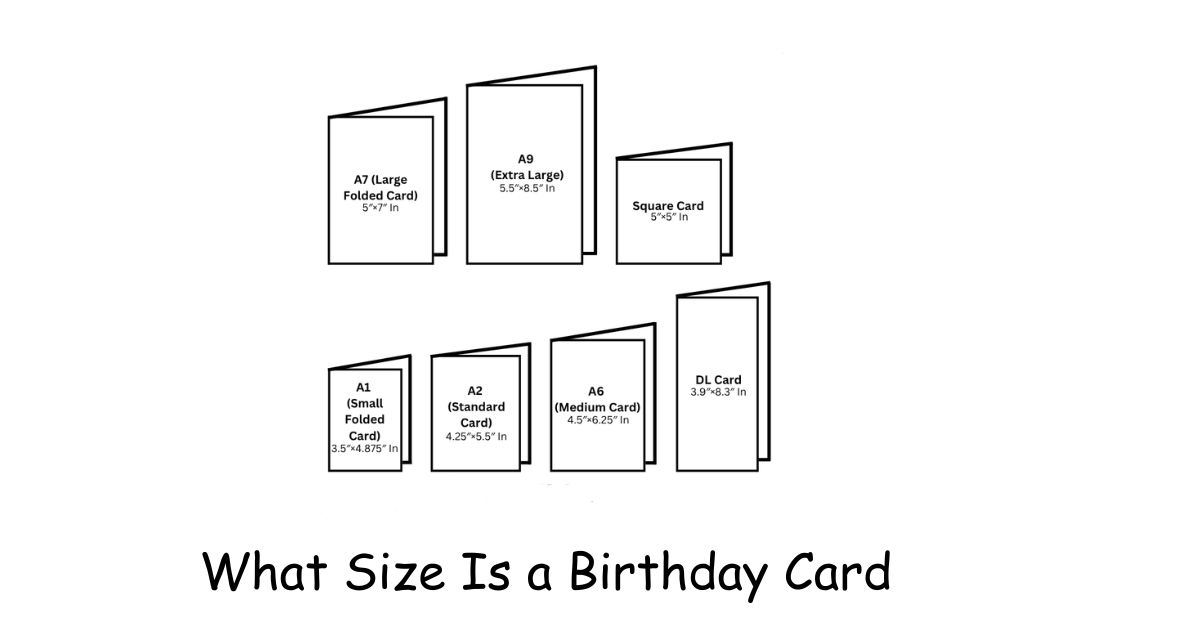
The most common birthday card size is 5 x 7 inches — that’s 12.7 x 17.8 cm, or 127 x 178 mm if you’re working in metric. It’s what you’ll find in most stores, what online print services default to, and what fits a standard A7 envelope without any drama.
That said, cards come in other sizes too, and picking the wrong one creates real problems — cards that bend in envelopes, designs that print blurry, postage that costs more than expected.
The Sizes That Actually Get Used
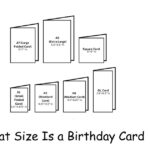
Most birthday cards fall into a handful of practical sizes. Here’s what they are and when each one makes sense:
| Size | Inches | mm | When to use it |
| Mini (A1) | 3.5 x 5 | 89 x 127 | Tuck-in gift tag, tiny note |
| A2 | 4.25 x 5.5 | 108 x 140 | Quick message, pairs with a big gift |
| A6 | 4.5 x 6.25 | 114 x 159 | Compact greeting, simple design |
| A7 (Standard) | 5 x 7 | 127 x 178 | Photos, longer messages, general use |
| Square | 5 x 5 or 6 x 6 | 127 x 127 | Modern aesthetic, Instagram-style look |
| Large | 8 x 10 | 203 x 254 | Group signatures, milestone birthdays |
| Panoramic | 3.9 x 8.3 | 99 x 210 | Landscape artwork, unusual layouts |
One thing to keep straight: these are folded measurements. Before folding, the card is twice as tall. A 5 x 7 card starts as a 5 x 14 inch sheet — or you trim an 8.5 x 11 piece of cardstock down to 7 x 10 and fold it through the center.
Read Also: Index Card Sizes: Which One Do You Actually Need?
Matching Cards to Envelopes
This is where most people run into trouble. They focus on the card, forget the envelope, and end up with corners bent or too much empty space inside.
The envelope should be just slightly larger than the card — enough to slide in cleanly, not so much that it shifts around.
- 5 x 7 card → A7 envelope (5.25 x 7.25 in)
- 4.5 x 6.25 card → A6 envelope (4.75 x 6.5 in)
- 4.25 x 5.5 card → A2 envelope (4.375 x 5.75 in)
- 5 x 5 square → 5.25 x 5.25 square envelope
One heads-up on square envelopes: USPS charges an extra surcharge (around $0.40) because square shapes can’t run through their sorting machines. Fine for one card, annoying if you’re mailing thirty.
Standard 5 x 7 cards in A7 envelopes mail as regular first-class letters. Cards with thick embellishments, glitter layers, or wax seals can push weight up enough to change the postage category — worth checking if you’re going all out on the design.
If You’re Designing One Yourself
Whether you’re using Canva, Photoshop, or a home printer setup, the pixel dimensions matter more than people expect.
For a card that prints sharp and clean, use 300 DPI. A standard 5 x 7 at that resolution is 1500 x 2100 pixels. For a 5 x 5 square it’s 1500 x 1500 pixels.
If the card is only going to be seen on a screen — emailed, texted, posted — you don’t need 300 DPI. Around 600 x 800 pixels at 72 DPI loads fast and looks good on mobile.
One detail that trips people up: bleed. If your design goes all the way to the edge, add 0.125 inches (about 3mm) of extra space on each side beyond the final card size. Printers trim after printing, and without bleed, you end up with a thin white border that wasn’t in your design.
US Sizes vs. How the Rest of the World Does It
In the US, greeting card sizes use an imperial system — inches, and letter-size paper (8.5 x 11) as the starting point. Most US card sizes are designed to cut cleanly from that sheet.
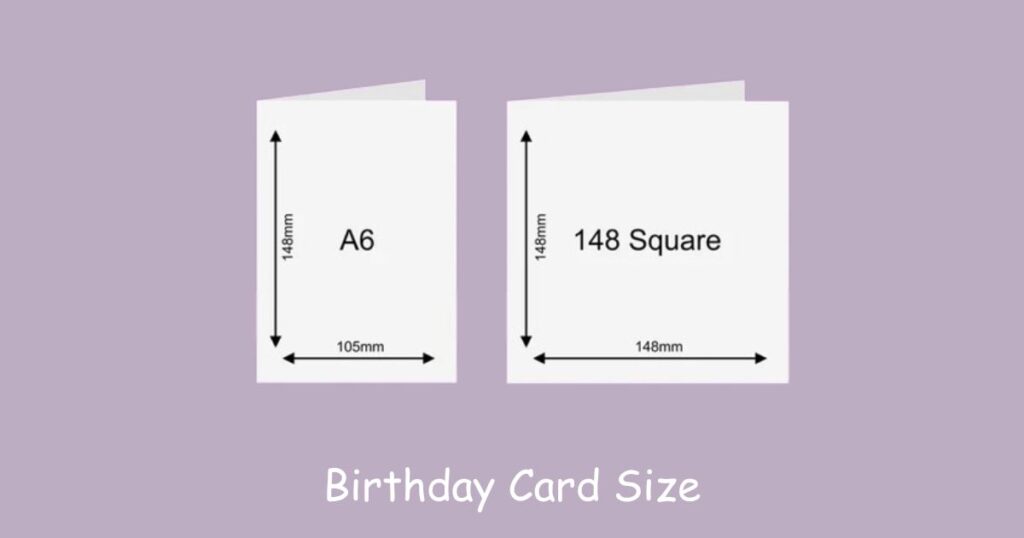
In Europe and most other countries, the ISO A-series is standard. A common European greeting card is A6 size — 105 x 148 mm. That’s close to the US A6 format but not identical, so if you’re ordering envelopes from an international supplier, double-check the exact measurements before assuming they’ll match.
Christmas cards follow the same sizing conventions as birthday cards — the 5 x 7 standard applies there too.
Things That Confuse People (And Shouldn’t)
Measuring the card open vs. folded. A 5 x 7 card is 5 x 7 when closed. Open it and you’re looking at 5 x 14. If your envelope isn’t fitting, check which measurement you used.
Thinking the paper size is the card size. An 8.5 x 11 sheet is raw material. The card is what you make from it after cutting and folding.
The A-size naming. In the US, “A7” refers to an envelope and card format. In the ISO system used internationally, A7 is a tiny paper size (74 x 105 mm). Same letters, completely different thing.
Skipping the bleed on print files. Removing bleed doesn’t ruin a card visually until it gets trimmed — then you notice the white edge immediately.
Choosing Based on What You’re Actually Doing
A small card paired with a big gift feels intentional and balanced. A massive card with a tiny gift looks like you ran out of ideas. Proportions matter more than people think.
For milestone birthdays — 40th, 50th, retirement — a large format (8 x 10) gives people room to write actual notes instead of squeezing signatures. For kids, bold colors on a standard 5 x 7 work well. For someone who keeps cards on their desk, 5 x 7 displays well standing upright.
If budget or simplicity is the priority, stay with 5 x 7. It’s the easiest size to find envelopes for, cheapest to print, and most familiar to work with.
Read Also: Flashcard Sizes: The Practical Guide Nobody Actually Writes
Common Questions
What size is a birthday card in pixels?
For printing: 1500 x 2100 pixels (5 x 7 at 300 DPI). For digital use only: around 360 x 504 pixels at 72 DPI.
What’s the standard greeting card size in mm?
127 x 178 mm — that’s the 5 x 7 inch standard converted.
Do I need special cardstock?
65 to 110 lb cardstock is the practical range. Regular copy paper folds messily and doesn’t hold up. Heavier cardstock feels more substantial but can be harder to fold cleanly without scoring first — drag a bone folder or the back of a butter knife along the fold line before creasing.
Can I use A4 paper for cards?
A4 (210 x 297 mm) is European letter-size paper. Folded in half, it makes an A5 card (148 x 210 mm) — bigger than a standard US birthday card but workable if you have matching envelopes.
The One Thing Worth Getting Right
Envelope fit. Everything else is flexible — size, shape, color, format — but a card that doesn’t sit cleanly inside its envelope looks careless before it’s even opened. Buy them together when you can, or verify the dimensions against each other before ordering separately.
Start with 5 x 7 if you’re unsure. It’s the default for a reason — not because it’s the most exciting option, but because it works every time without any surprises.

I am the editor and author of StoriesRadius.com, a blog about measurements and dimensions. I enjoy turning numbers and sizes into simple stories that anyone can understand. From everyday objects to curious facts, I share clear guides based on real research and experience. My goal is to make learning about length, height, and size fun, useful, and easy for all readers.