You bought a chess set online. It arrives, looks beautiful, and then you set it up — and something’s wrong. The pieces look cramped. Or worse, they’re swimming in empty space. You had no idea the board and pieces had to actually match each other. Nobody mentions that part.
This is what most guides skip. They give you numbers without telling you what to do with them.
The Grid Never Changes — But Everything Else Does
Every chess board is 8×8. That’s 64 squares, always. Half light, half dark.
What actually varies is how physically large those squares are. And that one variable changes everything — which pieces fit, how the game feels, and whether your setup looks right or ridiculous.
Square size is the measurement that matters. Not the total board size. Not the weight. The square.
Why People Look This Up
Someone ordering their first real set wants to know if what they’re buying will actually work together. A woodworker cutting a custom board needs exact numbers before touching the saw. A club player wants to know if their board passes tournament rules. A parent picking a gift just wants something that’ll hold up.
Each of these situations needs the same core answer: know your square size, and everything else falls into place.
The Numbers Behind Standard Boards
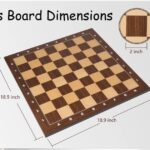
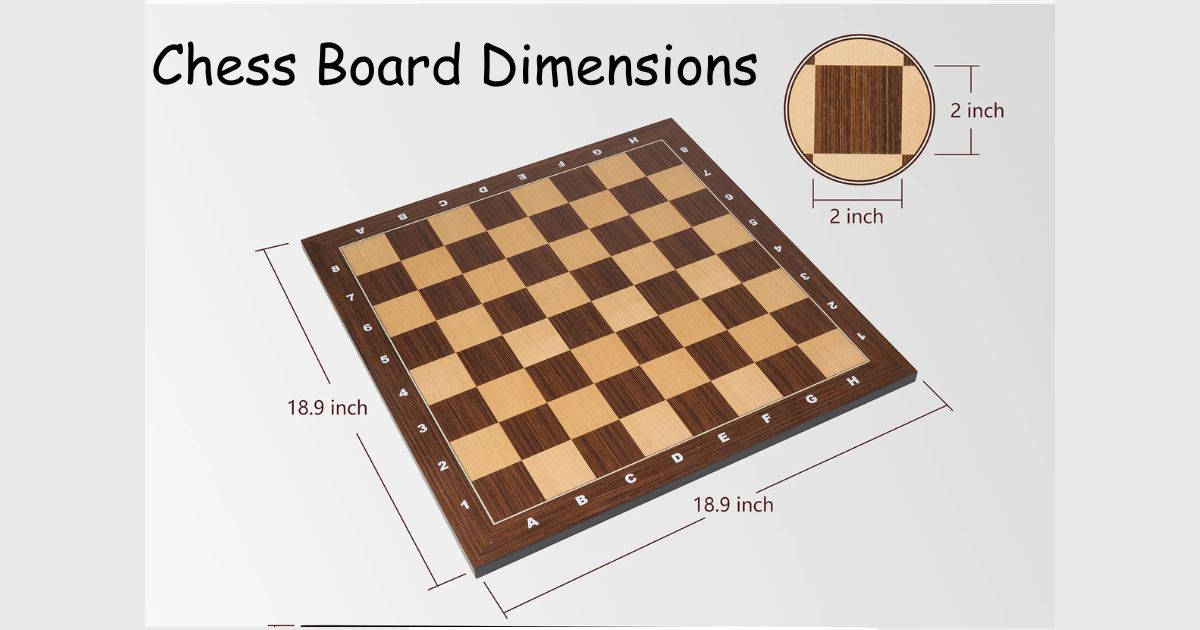
For casual home play, squares between 1.75 and 2 inches are typical. The board ends up somewhere around 16 to 18 inches total once you include the border frame around the grid.
For serious play, the range tightens. FIDE — the international chess federation — requires squares between 5 cm and 6.35 cm (roughly 2 to 2.5 inches). Most top-level events use 55 mm squares, putting the playing grid at 44 cm across. Add borders of about 4 cm per side and the full board lands around 52 to 55 cm square.
USCF, which governs US tournaments, prefers 2.25 inch squares. Boards total around 21 to 22 inches. That’s become the go-to benchmark for anyone buying a “proper” set in the US.
In millimeters, a competition-ready board runs 520 to 550 mm across the full surface. Worth knowing if you’re building or ordering something custom.
Matching Pieces to Board
This is the part nobody explains in stores or on product pages, and it’s the most practical thing in this whole article.
Your king is the reference piece. His base should cover roughly 75 to 80 percent of one square. That’s the rule. Not 100 percent — pieces need a little breathing room. Not 60 percent — they’ll rattle around and look wrong.
A king with a 1.75 inch base pairs with a 2.25 inch square. That’s 77 percent coverage. Works perfectly.
Here’s a sizing guide that covers most common sets:
| King Height | King Base | Square Size | Fits Best For |
| 3.25 in / 8.3 cm | 1.45 in / 3.7 cm | 2.0 in / 5.1 cm | Home use, beginners |
| 3.75 in / 9.5 cm | 1.75 in / 4.4 cm | 2.25 in / 5.7 cm | USCF tournaments |
| 4.0 in / 10.2 cm | 1.75 in / 4.4 cm | 2.25–2.5 in | Club play |
| 4.5 in / 11.4 cm | 2.0 in / 5.1 cm | 2.5 in / 6.4 cm | Display or tall sets |
A quick physical test: set four pawns into one square base-to-base. They should fit without hanging over the edges. If they spill over, you need bigger squares. If there’s a gap wide enough to lose a pawn in, you need smaller.
What the Border Does to Total Size
Two boards can have identical square sizes and still measure differently. That’s the border at work — the plain frame surrounding the grid.
Borders typically run 1 to 2 inches per side. A board with 2.25 inch squares and a 1 inch border measures about 20 inches total. The same squares with a 2 inch border push that to 22 inches. Both are legal for tournaments. Both use the same pieces. But they look and feel different on a table.
When shopping, always check the square measurement in the listing, not the total board size. “21 inch board” tells you almost nothing useful on its own.
Read Also: Flash Card Size: Everything You Need to Know Before You Make or Buy One
Board Sizes by Type
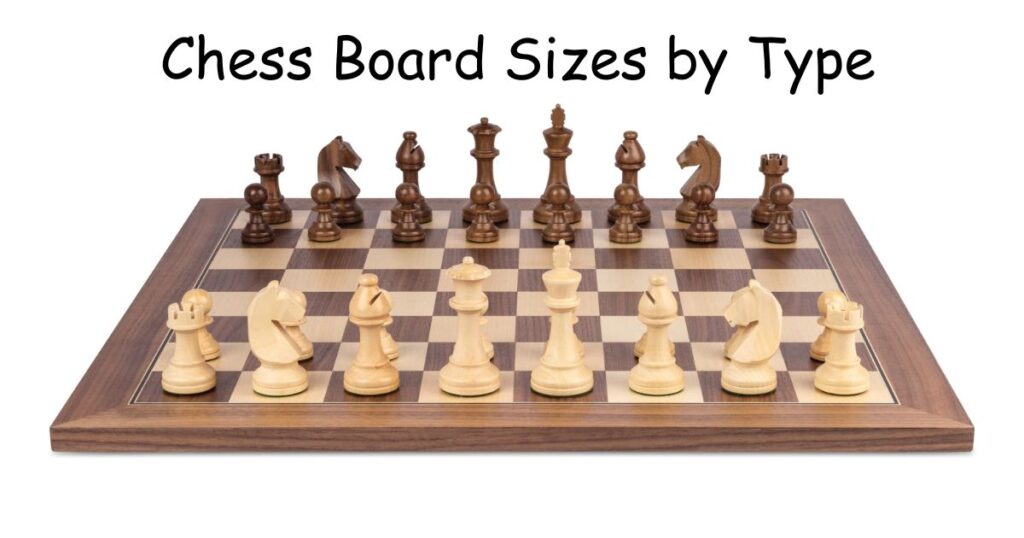
Travel boards fold or roll. They’re usually around 14 to 16 inches with squares closer to 1.75 inches. Fine for a bag, awkward for long games.
Home sets land in the 18 to 20 inch range. Comfortable for casual play, easy to find at most price points.
Tournament vinyl roll-ups come in at 20 to 21 inches with 2.25 inch squares. Thin, light, and packable — the practical choice for anyone playing regularly.
Luxury wooden boards in walnut or rosewood often hit 22 to 24 inches, sometimes more. Squares can stretch to 2.5 or 3 inches. These are as much furniture as they are game equipment. A marble version at 23 inches can weigh close to 20 pounds — stunning, but you’re not moving it to a tournament.
Material and Thickness
Wood boards run about 0.75 inches thick. They feel solid. Pieces land with a satisfying sound.
Stone boards — onyx, marble — go thicker, sometimes 1.5 inches. They look incredible but demand a sturdy surface underneath.
Vinyl is around 0.25 inches. It rolls without cracking and travels well. Not glamorous, but reliable.
Glass boards reflect light beautifully and pieces tend to slide. Better as a display piece than a game board.
The 204 Squares Puzzle
Most people know a chess board has 64 squares. Technically, it has 204.
Count every possible square of every size: sixty-four 1×1 squares, forty-nine 2×2 squares, thirty-six 3×3, and so on down to one 8×8 square covering the whole board. Add them up and you get 204. It’s a geometry trick hidden in the grid, and it’s why certain chess riddles get tricky fast.
If You’re Building One
Start with 55 mm squares. Eight across gives you a 440 mm grid. Add 40 mm borders on each side. Total board: 520 mm square, about 20.5 inches. Aim for 20 mm thickness — enough to feel solid without being heavy.
Use matte varnish rather than gloss. Pieces grip better and don’t slide mid-game. Gloss looks great in photos and frustrating in play.
Metric-to-imperial matters here: 2 inches is 50.8 mm, not 55 mm. Half a centimeter sounds like nothing until your squares are visibly off. Measure twice.
The History, Briefly
Medieval boards weren’t standardized. Some had 12 columns. Sizes varied by region and whoever made the board that week.
FIDE formalized the 8×8 grid with minimum square sizes in 1924. The specs refined through the 1950s into what exists today. USCF followed in the 1940s, emphasizing 2.25 inch squares post-WWII as the game spread more widely in the US.
The grid hasn’t changed since. A board made in 1924 to those specs still works in a 2026 match.
Common Mistakes Worth Knowing
Buying pieces and a board from different sellers without checking the king-to-square ratio — this is how most mismatches happen. Always verify the king base and square size before checkout.
Treating “standard size” as a guarantee. Sellers use that phrase for boards anywhere from 16 to 22 inches. It means different things to different people.
Mixing metric and imperial mid-calculation. 2 inches is not 5.5 cm. It’s 5.08 cm. Small difference, real consequences when you’re cutting wood.
Forgetting that borders add to the total. If your table is tight, account for the full board size including frame, not just the playing grid.
Read Also: Pokémon Card Dimensions: Everything You Actually Need to Know
Quick Questions, Direct Answers
What’s the standard chess board size in cm for tournaments?
50 to 55 cm total, with 5 to 6.35 cm squares. Most events use 55 cm boards.
What size in mm?
520 to 550 mm across the full surface. Squares at 50 to 63.5 mm.
How many squares on a chess board?
64 playable squares. 204 if you count every possible square of every size on the grid.
What square size works for a beginner set?
2 inch squares with a king around 3.25 inches tall. Easy to find, affordable, and proportional.
Do luxury boards use different dimensions?
They’re usually larger — squares from 2.5 to 3 inches, total board 22 to 26 inches — but they follow the same ratio rules for pieces.
What to Take Away
Ignore the total board size when you’re making a decision. It’s the square size that tells you whether pieces will fit.
Get the king-to-square ratio close to 75 to 80 percent, and the board will feel right. Stray too far in either direction and the whole setup suffers — no matter how good the wood looks or how well the pieces are carved.
If you’re buying a set with pieces included, test the pawn fit. If you’re buying board and pieces separately, check the king base against the square size before you commit. That one check saves most of the frustration.

I am the editor and author of StoriesRadius.com, a blog about measurements and dimensions. I enjoy turning numbers and sizes into simple stories that anyone can understand. From everyday objects to curious facts, I share clear guides based on real research and experience. My goal is to make learning about length, height, and size fun, useful, and easy for all readers.