You’re standing in a restaurant supply store — or scrolling through one online — and the listings say things like “full size 4/400” or “1/3 pan, 6-inch depth.” Nobody warned you there’d be math involved.
Or maybe you work in a kitchen already and someone just told you to “grab a couple thirds and two halves” and you nodded like you knew what that meant.
Either way, you’re here now. Let’s sort this out.
The Whole System Makes Sense Once You See This
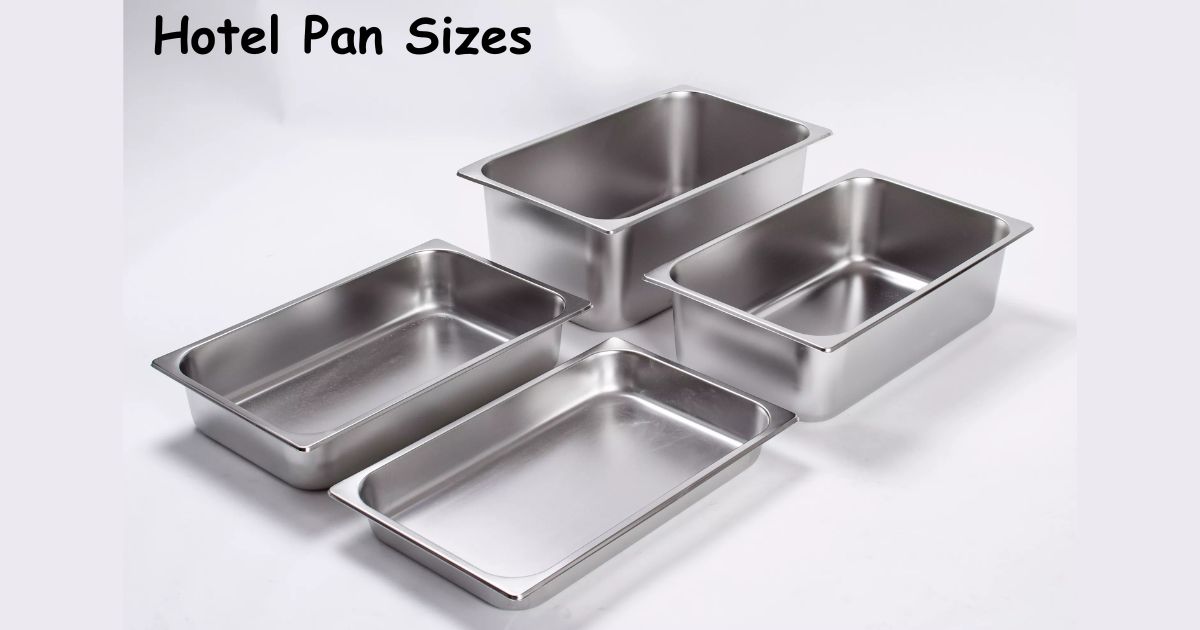
Every hotel pan size — no matter the brand, no matter the store — is based on one rectangle. One full-size pan. That’s the anchor for everything.
That full pan measures 20¾ inches long by 12¾ inches wide.
Every other size is literally a fraction of that space. A half pan takes up half that footprint. A third pan takes up one-third. A sixth takes up one-sixth. That’s not a metaphor — it’s exact. Three 1/3 pans placed side by side fill the exact same opening as one full pan. Six 1/6 pans do the same.
This matters because steam tables, prep tables, and chafing dishes are all built around that same full-size opening. Mix and match any fraction combination that adds up to one, and it fits.
The Size Breakdown
Here’s where dimensions actually live. These are U.S. standard measurements — what you’ll see on most domestic product listings.
| Pan Size | Dimensions (inches) | Fits in Full Opening |
| Full (1/1) | 20¾ × 12¾ | 1 pan |
| Two-Third (2/3) | 13⅓ × 12¾ | Pairs with one 1/3 |
| Half (1/2) | 12¾ × 10⅜ | 2 pans |
| Third (1/3) | 12¾ × 6⅞ | 3 pans |
| Quarter (1/4) | 10⅜ × 6⅜ | 4 pans |
| Sixth (1/6) | 6⅞ × 6¼ | 6 pans |
| Ninth (1/9) | 6⅞ × 4½ | 9 pans |
The 2/3 size trips people up because it’s less common. It’s wider than a half but shorter than a full. You’ll usually see it paired with a 1/3 pan sitting next to it — together they fill one full well perfectly.
The 1/9 is tiny. Smaller than your hand. It’s for garnishes, small condiments, or anything you’re serving in tablespoon-level amounts.
Now the Depth — This Is Where Most People Get Confused
The fraction tells you the footprint. The depth tells you the volume.
Same 1/2 pan, different depth — completely different capacity. This is the part people skip when ordering, then wonder why their soup barely fills the pan or their equipment doesn’t close properly.
Common depths you’ll actually encounter:
2½ inches — Shallow. Good for pastries, sliced deli meats, or anything that shouldn’t sit in pooled liquid. Not great for saucy dishes.
4 inches — The most useful middle-ground depth. Fits hot sides, casseroles, moist vegetables. This is the “default” depth most kitchens reach for.
6 inches — For soups, stews, rice, or anything you’re making in large volume. Holds significantly more than a 4-inch.
8 inches — Deep storage or transport. Not commonly used in service, but useful for moving large protein cuts or holding bulk prep.
On product listings, depth is written as a number code: 200 means 2-inch, 400 means 4-inch, 600 means 6-inch, 800 means 8-inch. So “1/2 400” means a half-size pan at 4-inch depth. That code saves space on labels — now you can read it.
Read also: Kitchen Trash Can Size: Guide to Find the Right Fit for Your Kitchen 2026
Capacity at a Glance (80% fill — the real working level)
| Pan Size | 2½” Depth | 4″ Depth | 6″ Depth |
| Full | ~6.6 qt | ~11.2 qt | ~16.8 qt |
| Half | ~3.4 qt | ~5.4 qt | ~8 qt |
| Third | ~2.1 qt | ~3.3 qt | ~4.9 qt |
| Sixth | ~1 qt | ~1.4 qt | ~2.2 qt |
Why 80%? Food expands. Liquid bubbles. People carry these pans across kitchens. Fill to the top and something goes wrong every time. The 80% rule isn’t caution — it’s just how it works in practice.
What Each Size Actually Gets Used For
Full pans are bulk pans. A 6-inch deep full pan can hold around 21 quarts of rice. That’s serious quantity. Full pans go in ovens, full steam table wells, and large transport carriers. Lasagna for 20-plus people, large protein roasts, anything you’re making in real volume.
Half pans are the most versatile size in existence. Two fit side by side in a full well. Easy to carry. Available in every material and depth. If someone asked you to stock just one size, half is the answer every time.
Third pans work beautifully for soups, individual desserts, pasta salads, stuffing — things where you want variety across a buffet without dedicating too much space to one item. Three across, one full opening, no wasted space.
Sixth pans are the topping pan. Shredded cheese, sliced jalapeños, chopped onions, olives, croutons — anything small that lives at a salad bar or sandwich station. Six fill a full well. They keep ingredients separated and make individual refills fast without disrupting the whole line.
Ninth pans sit in very specific situations. Drizzle sauces, garnishes, small amounts of something that would look ridiculous in a larger pan. You won’t need them often, but nothing else replaces them when you do.
Materials — Pick the Right One for the Job
Stainless steel handles the widest range of conditions. Freezer to oven, -40°F to over 400°F, without complaint. The gauge number indicates thickness — lower number means thicker metal. A 22-gauge pan handles daily commercial kitchen abuse well. A 24-gauge is lighter but less resistant to denting from heavy utensils.
Polycarbonate is clear plastic. You can see exactly what’s inside without lifting the lid. It’s lightweight, shatter-resistant, and works well in cold environments down to -40°F — but it tops out around 210°F, so no oven use. Salad bars, walk-in cooler storage, cold prep stations.
Polypropylene is a more affordable plastic option. Good chemical resistance, fine for cold storage, but limited heat tolerance. Use it for storing, not serving hot food.
Melamine looks like real dishware and fits upscale buffet displays where guests can see the pan. It chips when dropped and doesn’t handle extreme temperatures. Great for presentation, not for production.
| Material | Temp Range | Best For | Avoid |
| Stainless Steel | -40°F to 400°F+ | Cooking, hot or cold holding | Nothing much |
| Polycarbonate | -40°F to 210°F | Cold bars, cooler storage | Oven use |
| Polypropylene | Cold only | Storage, prep | Any heat source |
| Melamine | Limited | Display, chafing dishes | Temp extremes |
The GN System — You’ll See This on Labels
European kitchens and equipment use the Gastronorm system instead of U.S. fractions. GN 1/1 is the full-size equivalent — 530mm × 325mm versus the U.S. standard of about 527mm × 324mm. Close, but not identical.
The fraction logic is the same. GN 1/2 is half, GN 1/3 is a third, and so on. Where things get tricky is the rim profile and corner shape — slightly different between GN and U.S. pans, which affects how they stack. If you’re mixing imported equipment with domestic pans, test the fit before buying in quantity.
For most American kitchens this distinction rarely comes up. But if you’re ordering from an international supplier or working with European-made steam tables, it’s worth knowing what GN means on a label.
Things People Get Wrong
Ordering the wrong depth for their equipment. A 6-inch pan dropped into a steam table well that only accommodates 4 inches sits wrong, heats unevenly, and sometimes won’t close under a sneeze guard. Measure your well depth before ordering. Every time.
Confusing a standard half with a half-long. A regular 1/2 pan is 12¾ × 10⅜ inches — roughly square. A half-long (sometimes called a long half) is about 20⅞ × 6⅜ inches — narrow and stretched. Same total area, completely different shape. The half-long is designed for asparagus, baguettes, or long narrow items. They look nothing alike once you see them next to each other, but the name sounds identical in a verbal order.
Assuming the fraction covers the whole story. Two people can order a “1/2 pan” and get completely different capacities depending on the depth they chose. Always specify both — size and depth. “Half pan, 4-inch” is a complete order. “Half pan” alone is not.
Using metal utensils on plastic or non-stick pans. Scratches in polycarbonate create bacteria-harboring grooves. Scratches in non-stick coatings eventually contaminate food. This is easy to avoid — it just requires whoever’s working the line to know which pans need which utensils.
Read also: Standard Bathtub Dimensions: The Complete Size Guide 2026
A Few Accessories Worth Knowing
Lids come in three practical styles. Flat lids are for stacking and transport. Notched lids have a slot for a spoon or ladle so service can continue with the lid partially on. Hinged lids flip open and stay up, which works well for self-serve buffet setups.
Disposable liners are thin plastic inserts that fit inside a pan. For sticky dishes — barbecue, anything with a sugary sauce — they cut cleanup time significantly. Not essential, but useful for high-turnover service.
Anti-jam pan designs have a slightly different rim profile that prevents stainless pans from locking together when stacked. If you’ve ever tried to separate two tightly nested pans mid-service, you understand why this design exists.
Adapter bars fit across a steam table opening and let you mix odd-size combinations — like a 2/3 pan next to a 1/3 — without gaps where heat escapes. They’re cheap and solve a real layout problem.
Real Questions, Direct Answers
What size is a standard hotel pan?
The full-size pan is 20¾ × 12¾ inches. Everything else is a fraction of that footprint. Depth is a separate choice.
What are 1/2 hotel pan dimensions?
12¾ × 10⅜ inches. At 4-inch depth, it holds around 5.4 quarts when filled to 80%.
What are 1/3 hotel pan dimensions?
12¾ × 6⅞ inches. Three of them sit side by side inside one full well.
What does 1/6 pan size mean?
It occupies one-sixth of a full pan’s footprint — 6⅞ × 6¼ inches. Six of them tile perfectly into one full steam table opening.
Can stainless hotel pans go in a home oven?
Yes. Check that the pan fits your oven rack — a half pan usually fits most standard home ovens, a full pan often doesn’t.
What’s the difference between a hotel pan and a food pan?
Nothing. Same item, different terminology depending on the supplier.
The Part That Actually Matters When You Buy
Size fractions are universal. Depth codes are consistent. The material choice is the one decision where your specific use case matters most.
Hot cooking and general holding — go stainless, 22-gauge, 4-inch depth as the starting point. Cold prep and storage — polycarbonate for visibility, polypropylene if budget is the priority. Display situations — melamine if appearance matters to guests who can see the pan.
The single thing that causes the most ordering mistakes is not checking equipment well depth before buying pans. Do that first. Write the number down. Then match your pan depth to that measurement.
After that, the fraction system does the rest of the thinking for you.

I am the editor and author of StoriesRadius.com, a blog about measurements and dimensions. I enjoy turning numbers and sizes into simple stories that anyone can understand. From everyday objects to curious facts, I share clear guides based on real research and experience. My goal is to make learning about length, height, and size fun, useful, and easy for all readers.