You’re at the post office when the clerk asks, “What are the dimensions?” You freeze. You measured it this morning—or did you guess? Now you’re facing extra fees because the box is bigger than you claimed.
Getting box measurements right isn’t about math. It’s about knowing which edges to measure and avoiding costly mistakes.
What “Measure a Box” Actually Means
Outside measurements (external dimensions) are for shipping or truck loading. Carriers charge based on how much space your package takes up—they don’t care about the inside.
Inside measurements (internal dimensions) answer “Will this fit?” Box walls take up a quarter to half inch on each side, so a 12-inch exterior gives you about 11.5 inches of usable space.
Most mistakes happen when people measure the inside but tell the shipping company those numbers. The carrier measures the outside, and suddenly you’re paying more.
The Three Dimensions Explained
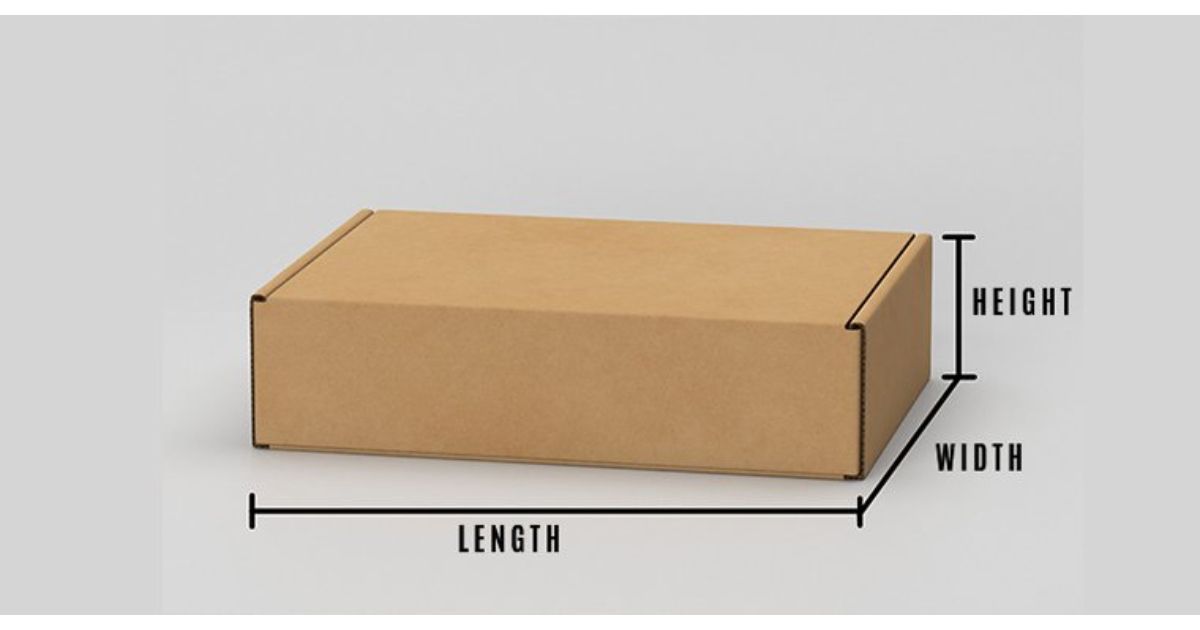
Length is the longest side of the base when looking down at the box flat.
Width is the shorter side on that same base, right next to the length.
Height is how tall the box stands upright, bottom to top.
A shoebox: the long side (heel to toe) is length, the narrow side is width, standing it up gives you height. Typically 13×8×5 inches.
Why L × W × H Order Matters
The entire shipping industry uses Length × Width × Height in that exact order.
An 18×16×12 box means 18 inches length, 16 inches width, 12 inches height. Mix up the order and automated systems might flag it wrong, billing you for a larger size category.
eBay, Shopify, warehouse systems, moving companies—everyone expects L×W×H.
How to Measure a Box
What you need: Flexible tape measure, flat surface, pen and paper.
Steps:
- Close all flaps completely (open flaps add phantom inches)
- Set the box so the largest flap faces you
- Measure edge to edge across that long side = Length (e.g., 24 inches)
- Rotate 90 degrees to the shorter base side
- Measure edge to edge = Width (e.g., 12 inches)
- Stand the box upright
- Measure straight up from bottom to top = Height (e.g., 10 inches)
Write it immediately: 24×12×10
Rounding rule: Carriers round UP to the nearest whole inch. Your 11.8 inches becomes 12 inches when they bill you.
Ruler vs. Tape Measure
Ruler: Fine for small boxes under 12 inches (jewelry boxes, small shoeboxes).
Tape measure: Necessary for anything larger. Most shipping boxes exceed 12 inches in at least one direction. A 16-foot tape measure costs $8 and handles boxes up to massive sizes.
Wardrobe boxes (24×21×48) physically cannot be measured with a ruler.
Inches vs. Centimeters
US carriers (UPS, FedEx, USPS) use inches only for domestic shipping.
Conversion: 1 inch = 2.54 cm
A 50×40×30 cm box = 19.7×15.7×11.8 inches, rounds to 20×16×12 for shipping.
If you’re used to metric, buy a tape measure with both scales. Measure once, read the inch side for US shipping.
Measuring for Shipping
Carriers measure the outside of your box after you hand it over. Bubble wrap making it bulge? Counts. Extra tape? Counts.
Carrier Size Limits
| Carrier | Max Length | Max Girth | Max Total (L+G) |
| USPS | 108 in | 130 in | 165 in |
| UPS Ground | 108 in | 165 in | 165 in |
| FedEx Ground | 108 in | 130 in | 165 in |
Dimensional Weight
Carriers charge whichever is higher: actual weight or “dimensional weight.”
Formula: (Length × Width × Height) ÷ 139
A 24×18×16 box full of pillows:
- 6,912 cubic inches ÷ 139 = 50 lbs billable weight
- Actual pillow weight: 8 lbs
- You pay for 50 lbs
Use the smallest box that safely fits your item.
What Is Girth?
Girth = distance around the thickest part of your package.
Formula: 2 × (Width + Height)
For a 24×12×10 box:
- (12 + 10) = 22
- 22 × 2 = 44 inches girth
Total package size: Length + Girth = 24 + 44 = 68 inches
Packages over 108 inches total trigger $30-$90 oversized fees. If you’re close, consider two smaller boxes instead.
Online Calculators
UPS and FedEx have calculators on their websites. Enter your dimensions, they calculate dimensional weight and total costs.
They’re great for checking math before quoting customers. But they can’t measure your box—you still need accurate input numbers.
Phone Apps for Measuring
Google Measure (Android) and Measure app (iPhone) use your camera to estimate dimensions.
Accuracy: Usually within half an inch on smaller boxes. That half inch rounds to a full inch, potentially bumping you into a higher rate.
Best use: Quick estimates when shopping for boxes or measuring many items fast. Always verify final shipping dimensions with a tape measure.
Mistakes That Cost Money
| Mistake | Why It’s Wrong | Fix |
| Flaps open | Adds 2-4 fake inches | Close them flat |
| Measuring diagonally | 12-inch side reads 13.5 | Keep tape straight |
| Rounding down | Carrier rounds up, creating discrepancy | Always round up |
| Ignoring bulges | Carrier measures widest point | Measure where it bows out |
| Mixing units | System thinks box is 2.54× larger | Stick to one unit |
One seller measured 500 boxes correctly and cut UPS bills by 22% annually—$3,000 saved with proper measuring.
Real-World Examples
Nike shoebox: 13×8×5
- Ships as-is or fits small flat-rate alternatives
U-Haul moving box: 18×18×16
- Cubic feet: (18×18×16) ÷ 1,728 = 3 cu ft
- Movers charge by cubic feet
Bike frame tube: 48 inches long, 4-inch diameter
- Treat as 48×4×4 box
- Girth: 2×(4+4) = 16
- Total: 48+16 = 64 inches
Measurement Checklist
- Close all flaps
- Longest base side = Length
- Adjacent shorter base side = Width
- Bottom to top = Height
- Write as L×W×H in whole inches (round up)
- Measure outside edges for shipping, inside for fitting items
FAQ‘s
Q: Do I measure with the box empty or full?
Measure after packing if contents make it bulge. Carriers charge for the actual size.
Q: What if my box is damaged or crushed?
Flatten it back to square or measure the pre-damage size. Carriers won’t accept crushed measurements.
Q: How do I measure irregular shapes?
Measure the widest points in each direction. For tubes, length along the tube, width/height as diameter.
Q: Do I need to measure packaging tape thickness?
If it makes the box noticeably bigger (excessive tape or foam), yes. Otherwise, no.
Q: Can I use internal dimensions for shipping?
No. Carriers bill based on external dimensions only.
Measure the longest base side, the shorter base side, then the height. Outside for shipping, inside for fitting things. Round up, use inches for US carriers, close those flaps.
Get it right once and it becomes automatic. Packages ship at the right price, storage plans work, and you stop second-guessing yourself at the post office.

I am the editor and author of StoriesRadius.com, a blog about measurements and dimensions. I enjoy turning numbers and sizes into simple stories that anyone can understand. From everyday objects to curious facts, I share clear guides based on real research and experience. My goal is to make learning about length, height, and size fun, useful, and easy for all readers.