You bought a jacket online. Size chart said “medium fits 17-inch shoulders.” You measured yourself, got 17 inches, ordered it—and the shoulders hang an inch past yours like borrowed clothes.
Here’s what happened: You measured your body. The brand measured their seam line. Two different things.
“Shoulder width” means three completely different measurements depending on what you’re doing. Buying clothes? You need the seam-to-seam width. Tracking gym gains? That’s bone-to-bone. Measuring alone? You’ll need tricks that don’t require help.
What Shoulder Width Actually Means
Your shoulders have two measurements that matter:
Biacromial width – the straight line between your shoulder bones (acromion points). This is skeletal structure. What fitness apps want and what determines your natural frame size.
Shoulder seam width – where the shoulder seam sits on a shirt or jacket. This sits about 1-2 inches below your actual bone, following fabric construction rather than anatomy.
When brands list “shoulder width” in size charts, they’re talking about seams. When your gym buddy says “I’ve got 18-inch shoulders,” he’s probably talking about bones. This mix-up is why clothes fit weird even when the numbers match.
Bone-to-Bone Method (Body Measurement)
Finding Your Acromion Points
Stand naturally. Raise one arm to the side, then drop it. Feel the bony point at the very top outer edge of your shoulder where it curves down into your arm? That’s your acromion. The hardest bump before everything slopes downward.
Not the muscle. Not the soft part. The bone that doesn’t squish when you press.
With Someone Helping
Stand relaxed, arms hanging loose, feet about shoulder-width apart. Don’t puff your chest or pull shoulders back—just breathe normally.
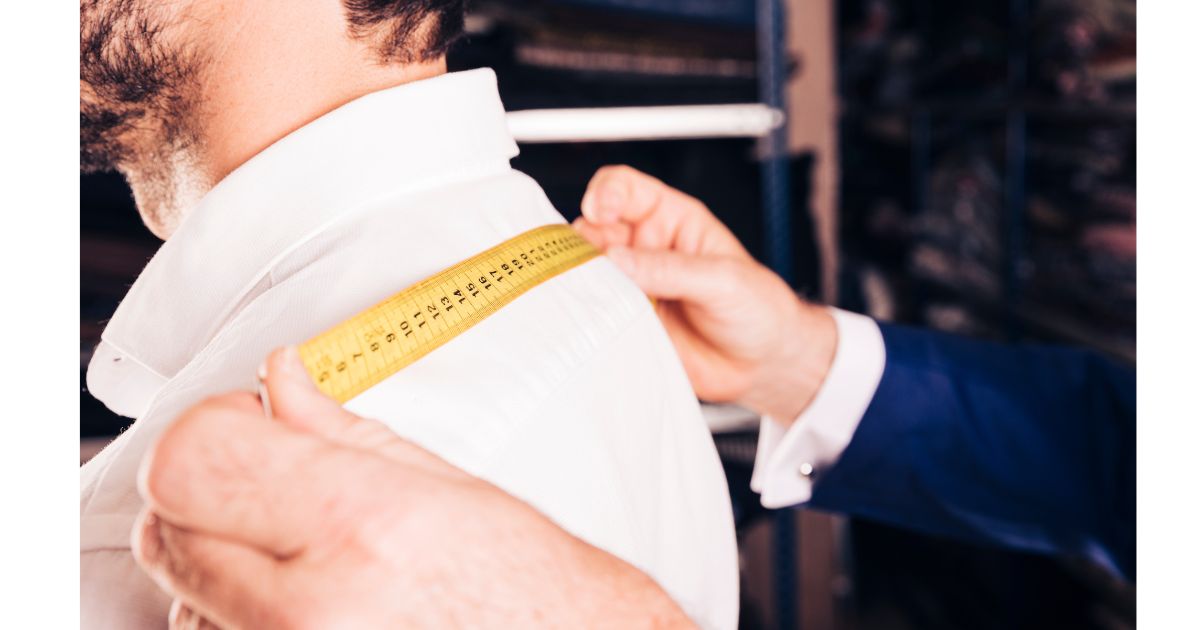
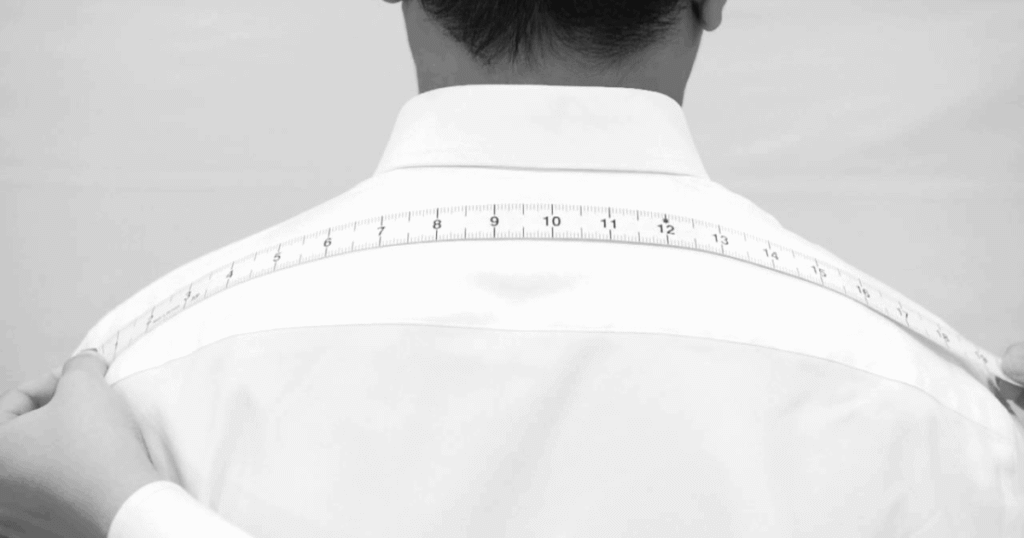
Your helper finds both acromion points and stretches a soft measuring tape straight across your upper back. The tape should be horizontal, not sagging. It crosses your spine somewhere between your shoulder blades.
Take three measurements and average them. You might get 16.5, then 16.75, then 16.5 again. Average gives you 16.58 inches, round to 16.5.
Men typically land between 15.5-17.5 inches. Women usually measure 13.5-15.5 inches.
Measuring Yourself (No Helper)
Wall marking trick: Stand with your back flat against a wall, heels touching it. Raise both arms out to the sides at shoulder height, then bend your elbows 90 degrees. Your shoulder tips should touch or nearly touch the wall.
Mark the wall at the outermost point of each shoulder with pencil or tape. Step away and measure between the marks.
This gets you within half an inch of the real number.
String alternative: Take non-stretchy string or dental floss. Hold one end at your left shoulder bone with your right hand. Drape the string across your back and hold the other end at your right shoulder bone with your left hand. Mark where your fingers grip the string, then measure that length flat on a table.
Accuracy drops here—maybe ±1 inch error—but it works when traveling.
Measuring Garments (Seam-to-Seam)
This is what you need for online shopping.
Grab a shirt or jacket that fits your shoulders perfectly. Lay it face-down on a flat surface. Smooth out all wrinkles, especially across the shoulders and back.
Find the shoulder seams—the lines running from the base of the collar out toward the sleeves. Measure straight across from where the left seam meets the sleeve to where the right seam meets the sleeve.
Don’t follow the curve of the fabric over the back—that’ll add 2+ inches. Pull the tape tight in a straight line.
| Garment Type | Typical Seam Width | Notes |
| Slim-fit dress shirt | 16-18 inches | Matches body closely |
| Regular t-shirt | 17-19 inches | Room for movement |
| Hoodie (standard) | 19-21 inches | Relaxed fit |
| Blazer/suit jacket | 17.5-19 inches | Sits on bone |
| Drop-shoulder tee | 20-23 inches | Oversized look |
Measure three of your best-fitting items in that category. A brand’s “medium” hoodie might have 20-inch shoulders while their “medium” button-up has 17.5. Sizes mean nothing—measurements mean everything.
Why Hoodies Confuse Everyone
Most hoodies have drop shoulders—the seam falls partway down your upper arm for that relaxed vibe. When you see “21-inch shoulders” for a medium hoodie, that’s often 3-4 inches wider than your bones.
Compare seam measurements to hoodies you already own, not to your body measurement.
Measuring Without a Tape Measure
Charging cable method: Most phone cables are around 36 inches. Lay it across your shoulders, mark with your fingers where the shoulder points hit, then measure that cable section against a ruler. Dollar bills are 6 inches long.
String and ruler: Hold non-stretchy string taut across your shoulders, mark or cut it, then measure it against anything with measurements—a ruler, a piece of paper (8.5 x 11 inches), a credit card (3.37 inches).
Hand span estimation: Your fist width is roughly 3.5-4 inches. Three fists across your upper back ≈ 12 inches. Not accurate for buying clothes, but gives you a ballpark.
Phone AR apps: “Measure” (iPhone) or “Google Measure” (Android) use your camera to measure objects. Stand in good lighting, have someone point the phone at your back. Calibrate first by measuring something you know the size of. Accuracy is about 85-90%.
Men vs. Women: What Changes
The technique is identical. What changes is fit expectation:
Men’s clothing usually puts the shoulder seam right at the acromion point. Structured look. Dress shirts and blazers especially—the seam should end where your shoulder ends.
Women’s clothing plays with shoulder placement more. Cap sleeves sit inside your shoulder, set-in sleeves right on the shoulder, drop shoulders down the arm. A women’s tee might have 15-inch seams but fit someone with 14-inch bones perfectly because of how it’s cut.
Average ranges:
- Men: 16-17 inches bone width, 17-19 inches garment seams
- Women: 14-15 inches bone width, 15-18 inches garment seams (wider range due to style variety)
Common Mistakes That Ruin Your Numbers
| Mistake | Real Impact | How to Spot It |
| Flexing or tensing | +1 to 2 inches | Tape feels tight across upper back |
| Measuring the curve | +2 to 3 inches | Number seems too big vs. clothes |
| Wrong starting point | ±1 inch | Measuring from arm socket instead of bone tip |
| Slouching/military posture | ±1 inch | Feels unnatural |
| Thick clothing | +0.5 to 1 inch | Varies by fabric |
| Single measurement | ±1 inch variance | Numbers jump around each try |
Most common: Following the natural curve of your back over the shoulder blade adds 20-30% to the measurement. The tape should be as straight as possible, even if it’s not touching your back the whole way.
Scenario-Specific Tips
Online shopping: Measure three similar items you own. Average those numbers. Only buy if the website’s measurement is within 0.5 inches of your average.
Blazers and suits: Add 0.5 inches to your bone measurement for ideal seam placement. Jackets should skim your shoulder bone without overhanging or pulling tight.
Alterations check: Shoulders are the hardest part to alter. If a jacket’s shoulders are more than 1 inch off, it’s basically unwearable unless you pay serious money. Get the shoulders right first.
Gym progress: Measure bone-to-bone monthly, same time of day, same relaxed posture. If you’ve got developed deltoids, your bone width might be 16 inches but your muscle width (flexed) could hit 18. Measure relaxed for clothing.
Traditional tailoring: Give your tailor the bone measurement and the seam measurement from a well-fitting garment. Traditional cuts tend to sit right on the shoulder bone, so accuracy matters for embroidery placement.
Quick Reference Guide
For buying clothes online:
- Lay your best-fitting item flat
- Measure seam to seam in a straight line
- Only buy items within 0.5 inches of that number
- Ignore the size label
For tracking fitness:
- Find the bony points at your shoulder tops
- Have someone measure straight across your back
- Stay relaxed, arms down
- Take three readings, average them
For measuring alone:
- Back against wall, arms out and bent
- Mark wall at shoulder tips
- Measure between marks
- Expect ±0.5 inch accuracy
No tape measure:
- String across shoulders, mark it, measure string later
- Phone AR app (calibrate first)
- Three fist-widths ≈ 12 inches (rough estimate)
Read Also: How to Measure a Box? (L × W × H Guide for Shipping & Storage)
Frequently Asked Questions
What’s the difference between measuring in inches vs. centimeters?
Just unit preference. Multiply inches by 2.54 to get centimeters. Most U.S. brands use inches, European brands use centimeters. Your tape measure likely shows both.
Should I measure over a shirt or bare skin?
Bare skin or a thin t-shirt at most. Thick clothing adds bulk that isn’t you. Hoodies can add a full inch.
Why do my measurements vary each time?
Your posture shifts slightly, the tape might twist, or you’re tensing up unconsciously. This is why you take three measurements and average them.
Can I measure from the front instead of the back?
Not accurately. Front measurements miss the natural slope of your shoulders and underestimate by about 20%. Always measure across the back.
How do I know if a garment has drop shoulders?
Lay it flat. If the shoulder seam is significantly wider than a regular shirt and would sit partway down your upper arm, it’s a drop shoulder. Compare to items you know fit normally.
What if my shoulders are uneven?
Most people have slight asymmetry. Measure to the wider side and use that number for clothing purchases. If one shoulder is noticeably higher, mention this when getting custom tailoring.
Do shoulder pads affect garment measurements?
Yes. Blazers and some jackets have padding that sits outside the seam. If you’re measuring a garment with shoulder pads, you’re getting the padded width, not the actual seam width. Remove or compress the padding when measuring, or note “with padding” in your records.
How often should I re-measure for fitness tracking?
Monthly at most. Shoulders don’t grow fast enough to warrant weekly checks. Same time of day matters—you can be slightly wider in the evening after training vs. first thing in the morning.
Measure twice, buy once, return never.

I am the editor and author of StoriesRadius.com, a blog about measurements and dimensions. I enjoy turning numbers and sizes into simple stories that anyone can understand. From everyday objects to curious facts, I share clear guides based on real research and experience. My goal is to make learning about length, height, and size fun, useful, and easy for all readers.