You bought the bed. You bought the sheets. Now you’re staring at a pillow wall in the store — or worse, squinting at a product page — trying to figure out if “king size” actually means what you think it means.
It should be a five-second answer. Somehow it never is.
The Number You Need
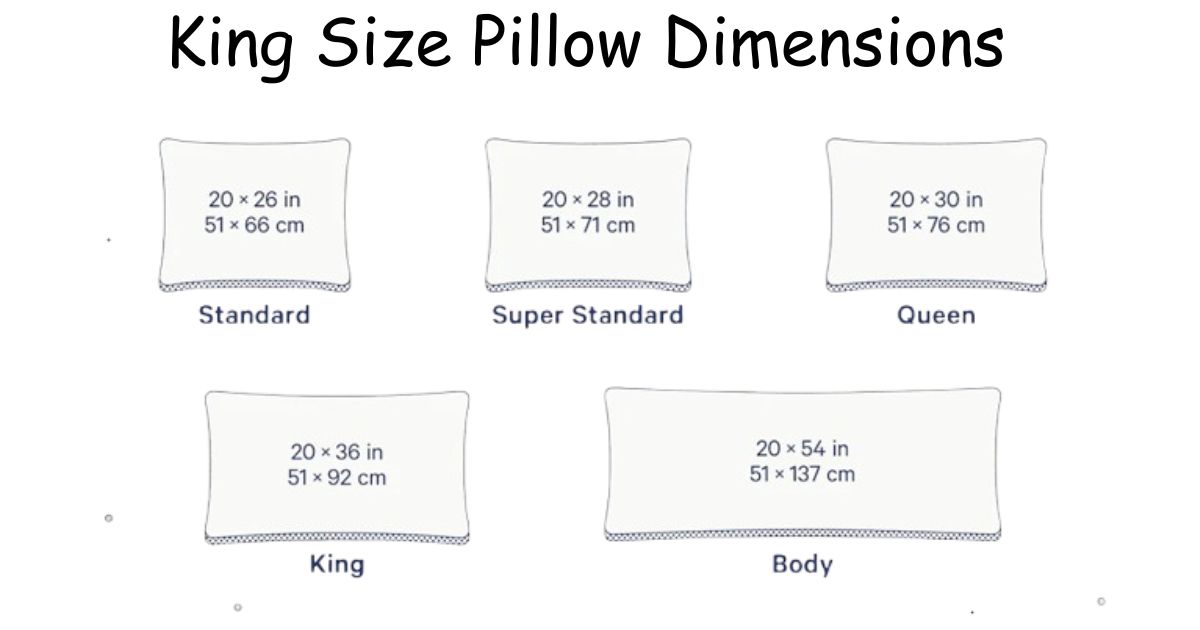
A king size pillow is 20 inches wide and 36 inches long. In centimeters, that’s 51 x 92 cm.
Width is the same as a standard or queen pillow — 20 inches. The length is what makes it a king. At 36 inches, it runs almost a full foot longer than a standard pillow. That extra stretch is why people who move around a lot at night actually like them. Your head stays supported even when you shift.
How It Compares to Every Other Size
| Pillow Type | Inches | Centimeters |
| Standard | 20 x 26 | 51 x 66 |
| Queen | 20 x 30 | 51 x 76 |
| King | 20 x 36 | 51 x 92 |
| Euro Square | 26 x 26 | 66 x 66 |
| Body Pillow | 20 x 54 | 51 x 137 |
Queen and king look close on paper. Six inches doesn’t sound dramatic. But on a bed, that difference is noticeable — especially if you share with a partner who migrates in their sleep.
The Country Problem Nobody Warns You About
US, Canadian, and Australian king pillows all land at 51 x 92 cm. Close enough that cases and shams are interchangeable.
UK sizing is a different story. Their “king” — sometimes called super king — runs closer to 50 x 90 cm. Two centimeters narrower, two centimeters shorter. That gap sounds harmless until you try stuffing a US king into a UK-sized case. You’ll get bunching at the corners and a sloppy fit that doesn’t go away no matter how much you adjust it.
If you’re ordering from an overseas retailer, check the actual measurements. Don’t trust the label alone.
What Kind of Shopper Are You?
People land on this topic for very different reasons, and the answer they need changes depending on where they’re starting from.
You just upgraded to a king bed. Two king pillows placed side by side fit the 76-inch width almost perfectly. That’s why hotel beds look the way they do — it’s not styled, it just works out mathematically.
You’re replacing a pillow and want an exact match. Lay your current pillow flat on a hard floor. Don’t fluff it, don’t squish it. Measure seam to seam, both directions. If it has a raised border around the edge (called a gusset), measure that height separately — gusseted kings typically add about 2 inches of height, which affects how they fit in cases.
You’re buying pillowcases and confused about sizing. A king pillowcase is not the same size as a king pillow. It’s intentionally bigger — around 20 x 40 inches (51 x 102 cm) in the US. The extra length gives the pillow room to slide in and lets the fabric tuck without pulling tight. If the pillow fills about 80–90% of the case without straining the seams, the fit is right.
You’re a side sleeper trying to fix neck pain. The 36-inch length helps keep your head supported when you shift positions. What matters more is loft — how thick the pillow is when filled. Side sleepers usually need 6 or more inches of height to fill the space between shoulder and ear. King dimensions give you the real estate; the fill determines whether it actually works.
Fill Type Changes Everything
Two king pillows can be identical in size and feel nothing alike. That’s the fill at work.
Down compresses and molds to your head. Soft, warm, and great for most sleep positions. Flattens faster than other types and can aggravate allergies.
Memory foam pushes back slowly and holds its shape. Good for side sleepers dealing with shoulder or neck issues. Tends to trap heat.
Latex bounces back quickly, resists dust mites naturally, and sleeps cooler than foam. Heavier than the others.
Polyester is the budget option. Fine for a guest room or a short-term fix, but most polyester-fill kings go flat within months.
Gel-infused options market themselves as cooler, and in humid climates, the difference is real — not just a selling point.
Adjustable-fill kings let you pull stuffing out until the loft matches how you sleep. If you’ve tried three pillows and none felt right, adjustable fill is worth trying before spending more.
Read Also: Pokémon Card Dimensions: Everything You Actually Need to Know
What Goes Wrong When People Buy Without Measuring
Buying a queen pillow and trying to use it in a king case — wrinkles everywhere, pillow slides around all night.
Buying two kings for a queen bed — they hang off both sides, eat up the whole sleeping surface, and look wrong.
Getting a king pillow for someone under 5’4″ — the length ends up pushing off the edge of the bed, and the width can push the head forward at a bad angle.
Ordering internationally without verifying the cm measurement — UK sizing passes as “king” but doesn’t match US cases.
None of these are huge mistakes. They’re just annoying ones that cost money to undo.
Care That Actually Extends the Life
King pillows hold more fill than smaller sizes, which means they take longer to dry and hold more moisture if you’re not careful.
Wash the pillowcase weekly. Wash the pillow insert every three months on a gentle cycle — use a large-capacity machine so it can move freely. Dry on low heat with a couple of dryer balls to keep loft from clumping.
Once a month, leave it somewhere with good airflow for a few hours. It cuts down on dust buildup and keeps the fill from packing down prematurely.
The fold test tells you when it’s time to replace: fold the pillow in half. If it stays folded instead of springing back, the fill is done. Most king pillows reach this point somewhere between one and two years depending on the fill type and how much you paid for it.
Layering and Room Aesthetics

Two kings standing upright against a headboard give a bed a full, clean look without much effort. Put a couple of 26 x 26-inch Euro squares in front of them and you get that layered look without it feeling overdone.
For guest rooms specifically, king pillows are a practical choice — they work for a range of heights and sleep styles without you needing to swap them out for different guests.
Skip them for kids’ rooms. The 36-inch length is awkward for small bodies and adds bulk without any real benefit.
Read Also: Chip Bag Sizes: What the Numbers Actually Mean Before You Buy
Questions Worth Answering Directly
Can a king pillow work on a queen bed?
One king pillow works fine for a solo sleeper on a queen. Two kings side by side is crowded and hangs over the edges.
Is a king pillowcase the same size as the pillow?
No — the case runs about 4 inches longer than the pillow. That’s intentional. It’s not a defect.
What’s the standard pillow size in cm for reference?
Standard: 51 x 66 cm. Queen: 51 x 76 cm. King: 51 x 92 cm. Euro square: 66 x 66 cm.
Does a king pillow actually help with sleep quality?
The size alone doesn’t. The right fill height for your sleep position does. King dimensions just give you more room to work with.
The Part That Actually Matters
Get the measurement right first: 20 x 36 inches, 51 x 92 cm. Make sure your pillowcase is sized for king (not queen). Verify you’re not ordering from a UK retailer if you have US cases.
After that, the decision comes down to fill — and that’s personal. Someone who runs hot needs different fill than someone who has shoulder pain. No amount of correct sizing fixes a pillow that doesn’t match how you sleep.
The dimensions are simple. Everything else just helps you use them well.

I am the editor and author of StoriesRadius.com, a blog about measurements and dimensions. I enjoy turning numbers and sizes into simple stories that anyone can understand. From everyday objects to curious facts, I share clear guides based on real research and experience. My goal is to make learning about length, height, and size fun, useful, and easy for all readers.