You thought this would be a five-minute decision. Then you opened three browser tabs, read four conflicting opinions, and now you’re more confused than when you started.
Here’s the thing — most articles about this topic say the same stuff in different fonts. This one won’t.
Let’s talk about what actually matters when you’re choosing between a mini crib and a full-size crib. No filler. No obvious advice. Just the real stuff.
The Size Gap Is Bigger Than You Think
People know mini cribs are smaller. What they don’t realize is how much smaller — and what that means for daily life.
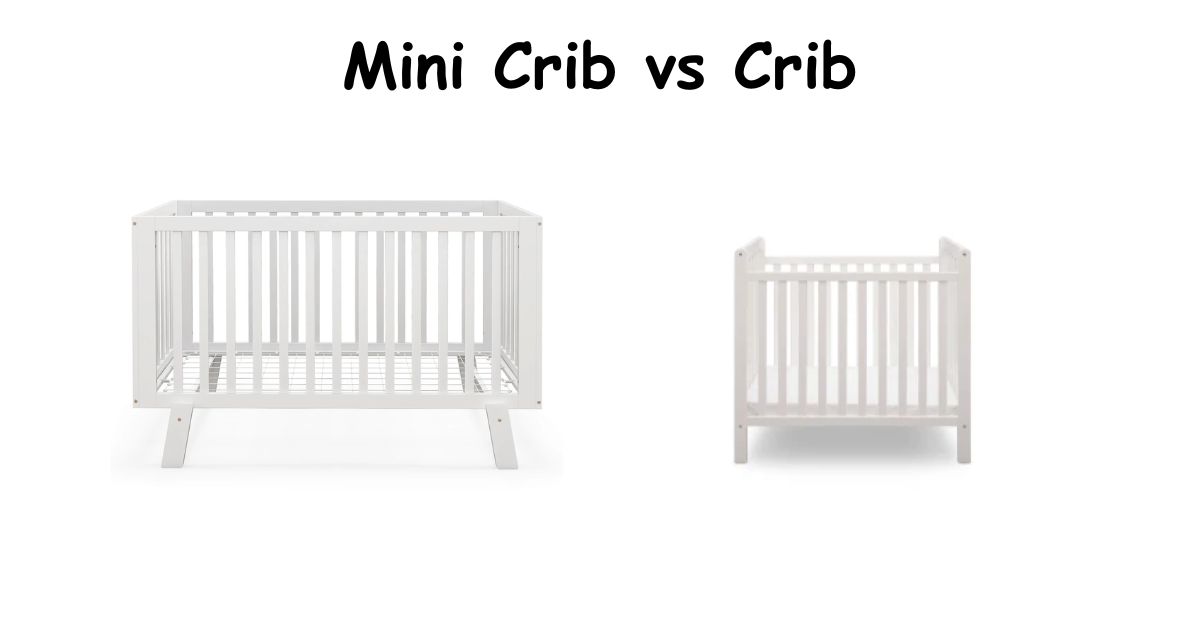
A full-size crib mattress is 28 inches wide and 52 inches long. A mini crib mattress is 24 inches wide and 38 inches long. That 14-inch length difference sounds fine on paper. In a small bedroom at 11 p.m., it’s the difference between a crib that fits beside your bed and one that blocks the closet door.
In centimeters: full-size runs about 71 x 132 cm. Mini sits at roughly 61 x 97 cm. For anyone measuring a tight corner, those numbers matter.
The full frame of a full-size crib takes up roughly 30–32 inches wide and 54–56 inches long. A mini crib frame? Around 26–28 inches wide and 40–43 inches long. You’re saving real floor space — not just an inch or two.
What Each One Is Actually Built For
A full-size crib is built for permanence. It’s heavy, stationary, and designed to stay in one room for years. Many convert to toddler beds, daybeds, or even full-size beds depending on the model. One purchase, long runway.
A mini crib is built for flexibility. It’s lighter, often wheeled, sometimes foldable. It works when space is tight or when you want baby close without a massive piece of furniture taking over your room.
Neither is “better.” They solve different problems.
The Cost Picture Nobody Draws Honestly
Mini cribs look cheaper upfront — and sometimes they are. You can find decent ones between $100 and $300. Full-size cribs range from $100 to well over $1,000 depending on the brand and features.
But here’s what the price tags don’t show you.
Most babies outgrow mini cribs somewhere between 12 and 18 months, sometimes sooner if they’re tall or hit their weight limit early (usually 35–50 lbs). After that, you’re buying something new anyway — a toddler bed, a full-size crib, whatever comes next.
A convertible full-size crib at $300–$400 can carry a child from birth to age three or four, sometimes longer. Spread that cost out and it’s often less per month than the mini crib plus the follow-up purchase.
This isn’t to say mini cribs are a bad deal. For some families, the flexibility is worth the shorter lifespan. Just go in with eyes open about the real total cost.
| Mini Crib | Full-Size Crib | |
| Mattress dimensions | 24″ x 38″ (61 x 97 cm) | 28″ x 52″ (71 x 132 cm) |
| Typical weight limit | 35–50 lbs | 50+ lbs |
| Usable age range | Birth to ~18 months | Birth to 3+ years |
| Price range | $100–$600 | $100–$1,000+ |
| Portability | Easy — often wheeled or foldable | Stays put |
| Bedding availability | Specialty sizes, harder to find | Available everywhere |
| Converts to toddler bed | Rarely | Often (convertible models) |
Read also: Crib Mattress Dimensions: Sizes, Safety Rules & What Actually Fits
The Bedding Problem Is Real
This doesn’t get enough attention. Mini crib sheets and mattresses are specialty items. You can’t grab one at a grocery store run or order any random fitted sheet online and expect it to fit.
Full-size crib bedding is literally everywhere. Every major store carries it. Sales happen constantly. You’ll never be stuck.
With a mini crib, you need the exact mattress size — 24 x 38 inches — because a slightly-off fit creates gaps, and gaps are genuinely dangerous for sleeping babies. Stock up on two or three fitted sheets when you find them because specialty sizes disappear from shelves faster than standard ones.
How It Feels Day-to-Day (The Stuff Reviews Skip)
Parents who love mini cribs usually mention one thing most: the ease of moving it. Rolling the crib from the bedroom to the living room during nap time, or shifting it for a house guest, or folding it for a trip — that kind of flexibility makes daily life smoother in ways you don’t fully appreciate until you have a newborn and zero spare energy.
Parents who regret mini cribs usually mention one thing: the surprise of outgrowing it. A 13-month-old who suddenly can’t comfortably sleep in their crib anymore is stressful. Not dangerous, just unexpected and inconvenient when you thought you had more time.
Parents who love full-size cribs usually mention the convertible feature. Watching the same frame become a toddler bed — and then a daybed — without spending another dollar feels like winning. Especially when a second baby arrives and the crib goes back into newborn mode.
Parents who struggle with full-size cribs almost always mention assembly and space. Two hours of assembly in a narrow room, followed by realizing the crib barely fits through the door, is a real experience many parents share.
Where Do Bassinets and Pack ‘n Plays Fit In?
These come up constantly in this conversation, so it’s worth clearing them up.
A bassinet is for the earliest weeks — typically birth to four or six months. It’s small, lightweight, and lives beside your bed. It’s not a replacement for a crib. It’s a bridge for the newborn phase.
A mini crib is what comes after, or instead of, a bassinet. It’s sturdier, has higher rails, uses a real mattress, and lasts up to two years. If you’re choosing between a bassinet and a mini crib for a primary sleep space, the mini crib gives you more time before the next transition.
A pack ‘n play has a similar mattress footprint to a mini crib — roughly 24 x 38 inches — but it’s designed for travel, not daily sleep. The mattress pad is thin. The frame folds and pops, which means some wobble. Fine for a weekend at grandma’s. Not ideal as an every-night solution.
The Safety Part — Kept Short and Practical
Both types need to meet current standards: slats no wider than 2⅜ inches, no drop sides, firm mattress with no more than a two-finger gap between mattress and frame.
Mini cribs with wheels need the wheels locked every time, every nap, every night. A wheeled crib near an uneven floor or stairs with unlocked wheels is a real hazard.
Check all hardware monthly. Frames that get moved around — rolled between rooms, folded for trips — loosen faster than stationary ones.
Buying secondhand? Check the CPSC recall database before using anything older than a few years. Drop-side cribs were banned in 2011 for good reason, and older models sometimes show up at secondhand stores.
Read also: Queen Size Blanket Dimensions: Exact Inches, CM & Meters Explained
Who Should Actually Get a Mini Crib
You’re sharing a bedroom with your baby, and there’s no separate nursery. You move between homes often — your place, a partner’s parents’ house, travel. You want baby close at night without a massive piece of furniture in your room. Your nursery has a real space constraint and a full-size crib genuinely won’t fit comfortably.
In those situations, a mini crib makes complete sense. Get a foldable or wheeled model, buy the right mattress size, stock extra sheets, and plan for the transition around the 12–15 month mark.
Who Should Actually Get a Full-Size Crib
You have the space. You want one purchase that lasts several years. You’re planning more than one child. You want easy access to bedding without specialty shopping. You’d rather spend a bit more now and not think about this again until your child is ready for a big-kid bed.
A convertible 4-in-1 model is worth the extra cost if any of that sounds like you. The long-term math almost always works in its favor.
Questions That Come Up A Lot
Can a newborn sleep in a full-size crib right away?
Yes. There’s no minimum age. A firm, properly fitted mattress is what matters — not the crib size. Some parents worry a full-size feels too big for a newborn, but babies sleep fine in them from day one.
What’s a mini crib size in cm?
Mattress: roughly 61 cm wide by 97 cm long. Full frame: around 66–71 cm wide by 102–109 cm long. Varies slightly by brand, so always check the specific product dimensions before buying a mattress.
Can I use a pack ‘n play mattress inside a mini crib?
Only if the dimensions match exactly — and you have to verify that per brand, not assume. Even a small gap is unsafe.
When do babies actually outgrow mini cribs?
Most hit the limit around 12–18 months. Taller babies or early climbers can hit it closer to 10–12 months. Weight limit (usually 35–50 lbs) is less often the issue than height and mobility.
Is a mini crib worth it for just one year?
For city apartments or room-sharing setups, many parents say yes without hesitation. If you have the space for a full-size, the value case is harder to make.
The One Thing Worth Remembering
The crib isn’t the decision that defines your baby’s first years. The decision that matters is whether it fits safely in your home, holds up through daily use, and doesn’t leave you scrambling for a replacement sooner than you planned.
Pick the one that matches how your household actually works — not the one that looks best in a nursery inspiration photo.
Both are fine. One just fits your life better than the other. You probably already know which one that is.

I am the editor and author of StoriesRadius.com, a blog about measurements and dimensions. I enjoy turning numbers and sizes into simple stories that anyone can understand. From everyday objects to curious facts, I share clear guides based on real research and experience. My goal is to make learning about length, height, and size fun, useful, and easy for all readers.