You measured your backyard. Looked decent. Then you searched “pickleball court dimensions” and suddenly you’re staring at PDF downloads, metric conversions, and zoning tips when all you wanted was — how big is this thing, exactly?
Fair. Let’s fix that.
The Court Is Smaller Than Most People Expect
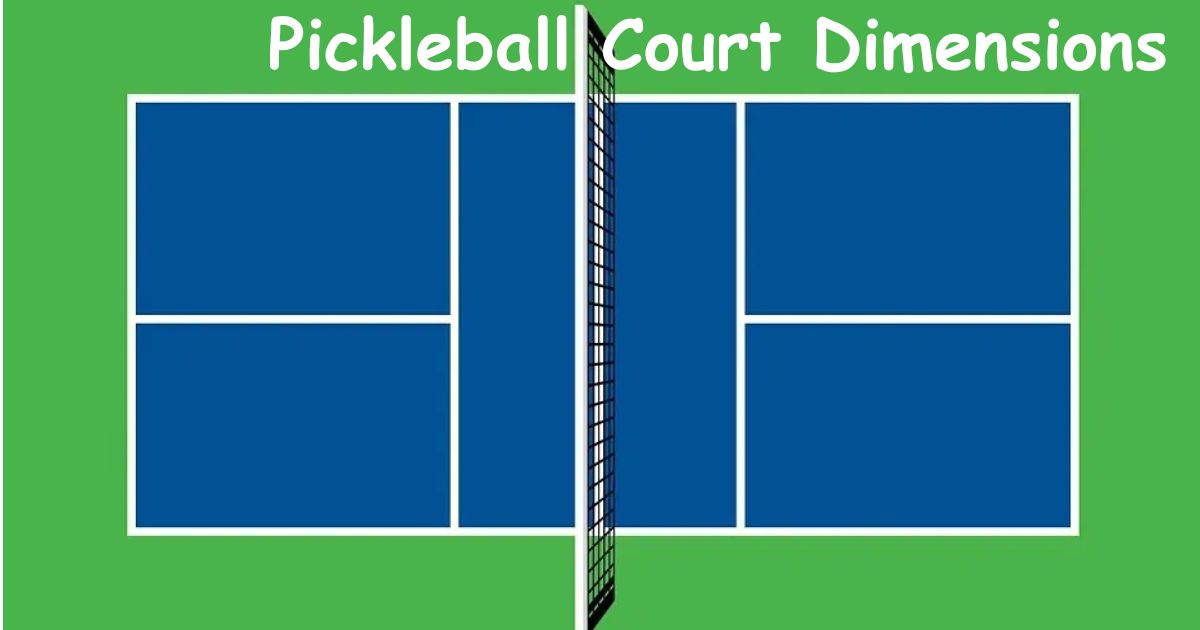
20 feet wide. 44 feet long. That’s a regulation pickleball court — same size whether two people are playing or four.
It fits in a two-car garage footprint. A driveway. A side yard. That compactness is literally why the sport grew so fast. People found room for it where tennis was never an option.
One thing that surprises newcomers: singles and doubles use the exact same court. Tennis expands the width for doubles. Pickleball doesn’t. 20 by 44, always.
All the lines are 2 inches wide, and here’s the part people mess up — you always measure to the outer edge of the line, not the inside. Gets the kitchen wrong, shifts the service boxes slightly. Sounds minor until you’re playing a competitive match on a court that’s off by a few inches.
Every Measurement in One Place
| Measurement | Feet / Inches | Meters | Centimeters |
| Court Width | 20 ft | 6.10 m | 610 cm |
| Court Length | 44 ft | 13.41 m | 1341 cm |
| Net Height — Sides | 36 in | 0.91 m | 91 cm |
| Net Height — Center | 34 in | 0.86 m | 86 cm |
| Kitchen Depth | 7 ft | 2.13 m | 213 cm |
| Each Service Box | 10 × 15 ft | 3.05 × 4.57 m | 305 × 457 cm |
The net dips 2 inches at the center. That’s not wear and tear — it’s by design. The lowest point of the net sits in the middle, which is why most shots during a rally go through the center. Players learn to use that.
The Kitchen: Seven Feet That Change Everything
The non-volley zone runs 7 feet from the net on both sides. Players call it the kitchen. Step inside it and you cannot hit the ball out of the air — you have to let it bounce first.
That one rule reshapes the entire game. It kills power plays near the net. It rewards patience. It’s what makes pickleball feel strategic rather than just fast. Two people standing at the kitchen line, trading soft shots — that’s called a dinking rally, and it can go on for a while.
The kitchen isn’t just the floor space. The line counts too. Touch it mid-volley and it’s a fault.
The Space Around the Court Matters Just as Much
Here’s where backyard plans fall apart. People measure 20 by 44, find out their yard fits, then realize there’s nowhere to actually run.
You need buffer room. The standard recommendation is 5 feet on each side and 8 feet at each end. That takes your total footprint from 20 × 44 to 30 feet wide by 60 feet long.
That’s 1,800 square feet of usable space for one court. Not 880.
If you’re putting courts next to each other — like converting a gym or building a small facility — the buffer between courts bumps up to 10 feet. You don’t want two players from adjacent courts colliding on a wide shot.
Fitting Multiple Courts Into Existing Spaces
This is where it gets practical for clubs, parks, and recreation centers.
The most common conversion happening right now: one tennis court becoming four pickleball courts. A doubles tennis court is 78 feet long and 36 feet wide. Four pickleball courts stack inside that space using shared side buffers. No new construction. Just new lines.
| Layout | Total Width | Total Length | Courts |
| One court with clearance | 30 ft | 60 ft | 1 |
| Two courts side by side | 50 ft | 60 ft | 2 |
| Four on a tennis court | 36 ft | 78 ft | 4 |
| Eight-court complex | 120 ft | 60 ft | 8 |
Two courts aligned lengthwise need 10 feet between the shared sidelines. Eight courts clustered together in an outdoor complex typically need about 120 × 60 feet when walkways are factored in.
Read also: Bocce Ball Court Dimensions: Backyard to Regulation Sizes Explained
How It Compares to Tennis and Badminton
A tennis court is roughly three times the size of a pickleball court. End to end in tennis, you’re covering nearly 60 feet. In pickleball, it’s 22. That difference is why people who gave up tennis years ago are back on a court — the physical demand is genuinely different.
Badminton is the interesting comparison. Doubles badminton is 44 feet long and 20 feet wide — almost identical to pickleball. If you’re converting a badminton court, barely anything changes. The footprint is the same. The difference is the net height and the absence of a kitchen zone in badminton.
Smaller Setups for Kids and Tight Spaces
No official governing body has a sanctioned “mini” court. But for kids or beginners, a common informal setup is 36 feet long by 18 feet wide — half the baseline, same width. Rallies are shorter, running is reduced, and younger players can actually build skills without covering too much ground.
For driveways, portable nets and vinyl floor tape work fine. You still want to aim for that 30 × 60 total area. Many casual players work with less, though — and the game still happens.
Wheelchair pickleball uses full standard dimensions. The only modification is a small adjustment to how the kitchen rule applies for mobility, not the court itself.
Indoor gyms need one thing above all else: walls at least 8 feet away from the sidelines. Closer than that and someone’s going into the wall on a wide ball.
Building a Permanent Court: The Honest Picture
A flat, level surface — concrete or asphalt — is the base. The slope should be around 1% for drainage. Too much slope and the ball starts behaving differently on each half of the court.
Professional installation runs roughly $25 to $50 per square foot. For a full 30 × 60 slab with fencing and lighting, you’re looking at a real investment. A backyard DIY job on existing concrete — just lines and a portable net — can cost a few hundred dollars.
Lighting for night play should reach about 100 foot-candles. Fencing around 10 feet high keeps balls in and cuts down on chasing.
Check zoning rules before you pour anything. Some municipalities require permits for outdoor courts. HOA approval, if relevant, is worth getting in writing before work starts.
Marking Lines Without Getting It Wrong
Start at the center. Stretch a string across the 20-foot width where the net will go. From there, measure 22 feet toward each end for baselines. Mark the kitchen lines 7 feet from the net on both sides. Split each half down the middle — the 10-foot mark — to create the left and right service boxes.
Paint or tape at exactly 2 inches wide, always to the outer edge. Pickleball-specific stencil kits make this much cleaner than freehand work.
Read also: Baseball Card Size: Inches, MM, Pixels & Everything You Need to Know
The Mistakes Worth Knowing Before You Start
Measuring to the inside of lines shifts everything just enough to cause problems in actual play. Outer edge, always.
No buffer space is the most common backyard mistake. The court fits, the buffer doesn’t, someone dives for a shot and hits a fence post.
Surface flatness matters more than people think. Over 1/8 inch of variance per foot creates unpredictable bounces. Use a level before committing to a surface.
White lines in direct sun can glare badly. Yellow reads better in bright conditions. Either is legal — yellow is just more practical outdoors.
Questions That Come Up a Lot
Is a pickleball court the same in feet as in meters?
The numbers just translate. 20 ft = 6.10 m, 44 ft = 13.41 m. The kitchen at 7 ft is 2.13 m. Same court, different units.
Can you use a pickleball court for tennis?
Not really. The court’s too short and the net is lower than a tennis net. Fine for casual hitting, not for actual tennis.
Where do I find an official diagram?
USA Pickleball publishes free PDFs with every line labeled. Their official rulebook has the full court diagram — worth downloading before you mark anything.
What surface works best?
Concrete outdoors is the smoothest to paint and most durable. Asphalt works too. Indoors, modular sport tiles or hardwood. Whatever surface, it needs grip — smooth concrete without texture becomes slippery when wet.
The One Thing to Get Right First
Total space. Not court size — total space.
20 × 44 is the playing area. 30 × 60 is what you actually need. Most planning problems — courts that feel cramped, buffer zones that disappear, fencing that sits too close — come from focusing on the court lines and ignoring everything around them.
Get the full footprint right. Everything else is just paint.

I am the editor and author of StoriesRadius.com, a blog about measurements and dimensions. I enjoy turning numbers and sizes into simple stories that anyone can understand. From everyday objects to curious facts, I share clear guides based on real research and experience. My goal is to make learning about length, height, and size fun, useful, and easy for all readers.