There’s a moment every collector hits — you order 100 sleeves, they arrive, and the cards don’t fit right. Too tight, too loose, or the toploader keeps spitting the card back out. It’s annoying, and it’s completely avoidable once you know the exact numbers.
This isn’t a generic spec sheet. Think of it as the guide a more experienced friend would walk you through.
The Numbers You’ll Actually Use
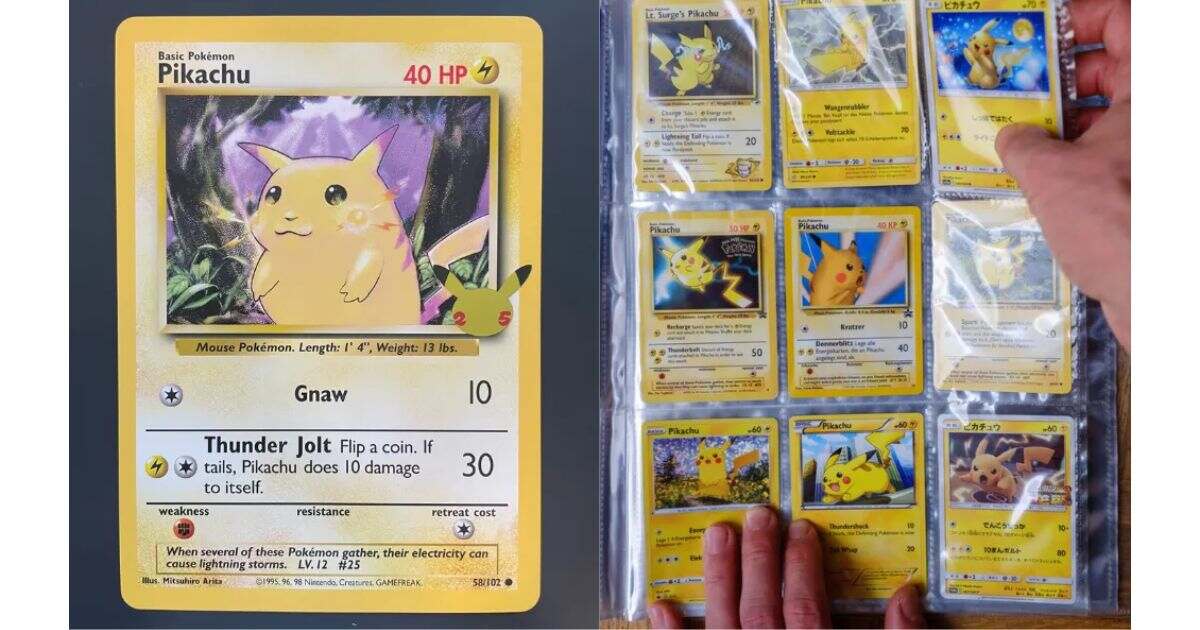
A standard Pokémon card is 2.5 inches wide and 3.5 inches tall. Every card, from Base Set to the newest release, has kept this size since 1996.
| Unit | Width | Height |
| Inches | 2.5″ | 3.5″ |
| Millimeters | 63.5 mm | 88.9 mm |
| Centimeters | 6.35 cm | 8.9 cm |
If you’re shopping for supplies on an international site — especially from European or Japanese sellers — they’ll list in mm. Now you’re ready for that.
One physical comparison that sticks: a Pokémon card is almost exactly the same width as a credit card (which is 85.6 mm wide). The Pokémon card is just taller. So if you can picture a credit card, stretch it upward slightly — that’s your card.
What Makes the Size Feel the Way It Does
Two details that don’t get talked about enough: thickness and corner radius.
Each card is about 0.012 inches (0.305 mm) thick — roughly the width of three human hairs side by side. Holo cards land a hair heavier (between 1.7 and 1.9 grams) because of the foil layer underneath the artwork.
The rounded corners have a 3–4 mm radius. That curve isn’t decorative. It lets cards slide off each other cleanly when you’re shuffling 60 cards fast during a match. Sharp-cornered fakes snag and jam constantly — which is actually one of the ways experienced players recognize counterfeits before even looking closely.
Sleeves and Toploaders: Match the Card to the Protection
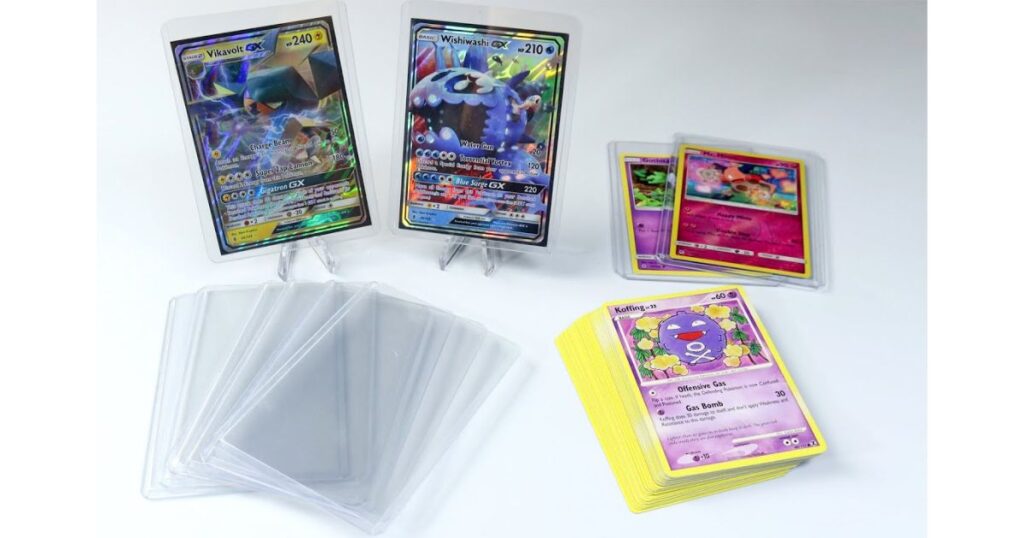
The card is 63.5 × 88.9 mm, but sleeves need to be slightly bigger so the card slides in without stress. The right sleeve size is 67 × 91 mm (2.64 × 3.58 inches).
That few extra millimeters of space matters more than it sounds. Too tight and you’re bending corners every time you insert a card. Too loose and the card rattles around and picks up micro-scratches.
| Protector Type | Size | Thickness | Use Case |
| Penny sleeve | 2.64 × 3.58″ | Very thin | Inner layer, sits under outer sleeve |
| Standard sleeve | 2.64 × 3.58″ | Thin | Play and everyday storage |
| Toploader | 3 × 4″ | 35pt | Single-sleeved cards |
| Thick toploader | 3 × 4″ | 55pt | Double-sleeved or bulkier VMAX cards |
The mistake most people make: buying 35pt toploaders and then trying to fit a double-sleeved card inside. The two sleeves add thickness and the card either won’t go in or it creases going in. If you double-sleeve, go straight to 55pt.
Comparing Pokémon Cards to Other TCGs
Pokémon cards share their exact dimensions with Magic: The Gathering cards. Same width, same height, same sleeves. If you play both games, your sleeves and toploaders work across both collections with no issues.
Yu-Gi-Oh! cards are a different size entirely — 59 mm × 86 mm. That’s noticeably smaller. A Yu-Gi-Oh sleeve on a Pokémon card will buckle within hours, and the card will develop creases along the edges where it’s being pushed against the tighter fit.
For Digital Designers: Getting Pixels Right
Physical dimensions don’t mean much when you’re working in Canva or Photoshop. What you need is the pixel count, and that depends on what the design is going to be used for.
| Purpose | Canvas Size | DPI |
| Screen preview / social media | 178 × 249 px | 72 |
| Home printing | 750 × 1050 px | 300 |
| Print shop / high-quality output | 1488 × 2078 px | 600 |
300 DPI is where most people should work. It gives sharp, clean prints on a home printer without creating a file so large your computer slows down. If you’re ordering prints from a shop or making cards as gifts, go 600 DPI and you won’t see a single blurry edge.
The aspect ratio of the card is 5:7 (roughly 1:1.4). Always lock this ratio when resizing in any design program. If it shifts even slightly, faces distort and borders misalign — it’s subtle but immediately noticeable when the card is printed and held.
Setting Up in Canva
Go to “Custom size” and enter 2.5 × 3.5 inches. Canva’s Pokémon card templates are preset to this, but some community templates use 744 × 1040 px which is slightly off — just resize to 750 × 1050 before exporting.
Setting Up in Photoshop or GIMP
New document → 750 × 1050 px → 300 DPI → RGB color. For the most accurate layout, scan a real card at 300 DPI and use it as a reference layer. Delete it before exporting. This method catches proportion errors before printing wastes cardstock.
Print on 11.5 pt cardstock and use a 3 mm corner-rounding punch for cuts that feel like the real thing.
Read Also: How to Measure a Box? (L × W × H Guide for Shipping & Storage)
Jumbo Cards: A Completely Different Beast
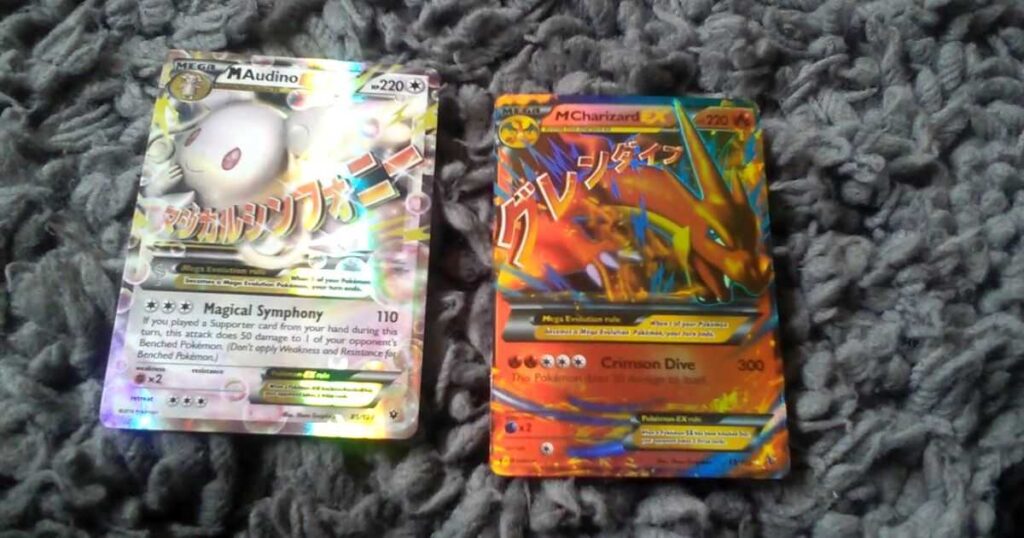
Jumbo Pokémon cards — the large promo cards that come in gift tins and special sets — don’t play in any official format. They exist for display, and they come in two sizes depending on when they were made.
| Variant | Width | Height |
| Pre-2020 Jumbo | 5.7″ / 145 mm | 7.87″ / 200 mm |
| Post-2020 Jumbo | 5.37″ / 136 mm | 7.37″ / 187 mm |
The size change in 2020 catches people off guard when they’re buying frames. An A5 frame (148 × 210 mm) works well for older jumbos. For post-2020 versions, a 4 × 6 photo frame with a mat board insert fits better.
Many collectors skip sleeves entirely for jumbos and go straight to framing. The artwork on a jumbo Charizard or Umbreon at wall size looks genuinely striking — much better than sitting inside a binder that nobody opens.
Using Dimensions to Catch Fake Cards
A digital caliper costs around $10 and it’s one of the most useful tools for buying singles online or at conventions. Real cards measure exactly 63.5 × 88.9 mm. A fake might be 64 mm wide or 87.5 mm tall — small enough to miss by eye, obvious enough with a caliper.
Other things to check physically: the card should flex smoothly and spring back. Fakes are often stiffer or don’t return to flat after bending. Real corners are soft and rounded. Cards that feel too thick, too light, or too plasticky deserve a closer look before any money changes hands.
Shipping Cards Without Damage
For sellers and traders, the card going from your hands to a buyer’s hands in perfect shape is everything.
A card in a toploader, wrapped in a team bag, fits inside a #10 envelope or a 5 × 7 photo mailer. The toploader should be taped shut so the card can’t slide out in transit.
For anything worth more than a few dollars, sandwich the toploader between two pieces of cardboard cut slightly larger than the toploader, then put it in a bubble mailer. The card won’t flex, won’t shift, and arrives flat every time. Write “Do Not Bend” on the outside — it doesn’t stop automated sorting machines, but it helps with human handlers.
Storage That Actually Works at Scale
9-pocket binder pages are sized for standard sleeved cards. A 3-ring binder with 40 pages holds 360 cards and takes up less shelf space than you’d expect.
Deck boxes built for 60 sleeved cards measure about 3 × 4 × 1.5 inches internally. That internal height accounts for sleeve thickness, so cards sit without being crushed.
Magnetic one-touch holders are for displaying a single card. They grip flat, look clean on a shelf, and come in 35pt or 55pt — same sizing logic as toploaders.
If you’re ever submitting to PSA or BGS for grading, use card savers rather than toploaders. Grading services prefer them because the semi-rigid material doesn’t stress card edges during submission handling.
Read Also: How Big Is 30 cm? 12 Common Things That Are 30 cm Big
Fast Answers to Common Questions
What size sleeve fits a Pokémon card?
67 × 91 mm. This works for both Pokémon and Magic: The Gathering cards.
Can I use Yu-Gi-Oh sleeves?
No — they’re 59 × 86 mm and too small. They’ll damage edges over time.
What’s the pixel size for a Pokémon card template?
750 × 1050 px at 300 DPI for printing. 1488 × 2078 px at 600 DPI for professional-quality output.
Are all Pokémon cards the same size?
Standard play cards are. Jumbo/promo cards are larger and come in two different sizes depending on whether they were produced before or after 2020.
How do I know if a card is fake by size?
Measure with a caliper. Real cards are 63.5 × 88.9 mm. Being off by 1 mm is a red flag.
What toploader do I need for a double-sleeved card?
55pt. The 35pt won’t fit without damage.
Once you have these numbers locked in, the rest of the hobby gets easier. Sleeves stop being a guessing game. Custom card designs print right the first time. You stop paying for fakes. It’s one of those small things that quietly makes everything else work better.

I am the editor and author of StoriesRadius.com, a blog about measurements and dimensions. I enjoy turning numbers and sizes into simple stories that anyone can understand. From everyday objects to curious facts, I share clear guides based on real research and experience. My goal is to make learning about length, height, and size fun, useful, and easy for all readers.