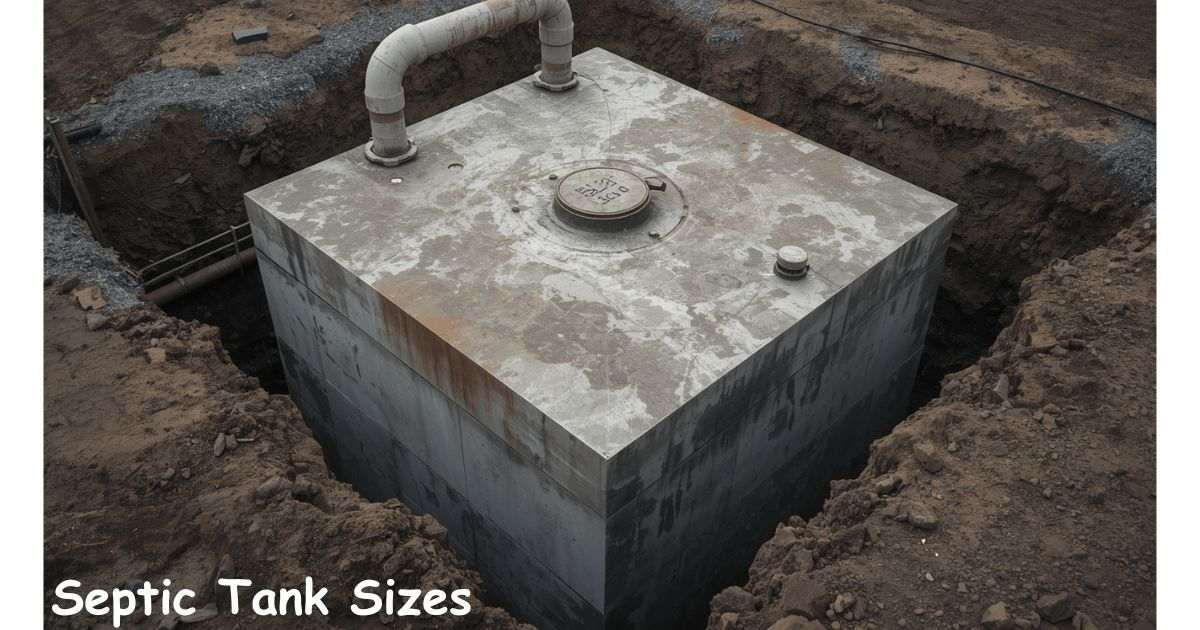
You’re standing in a contractor’s office or scrolling through a supplier’s website, and they’re throwing numbers at you — 1,000 gallons, 3,785 liters, 8.5 by 5 feet. You nod like it makes sense. It doesn’t yet. That’s fine.
Septic tank sizing has a reputation for being technical. It’s really not. Once you see how the numbers connect to real life — your house, your family, your yard — it clicks fast.
It All Comes Down to Time
Here’s the core idea most people never hear explained plainly.
Your tank’s only real job is to hold wastewater long enough for solids to sink, grease to float, and bacteria to start breaking things down. The liquid in the middle eventually drains out to the soil. That process needs roughly three days to work properly.
So tank size isn’t about storage. It’s about time. A bigger tank gives wastewater more time to sit and separate before draining out. Too small, and everything rushes through — solids, grease, partially treated liquid — straight into your drain field. That’s when the field clogs, the ground gets soggy, and the repair bill shows up.
That’s the whole concept. Everything else is just math.
The Number Your Permit Office Actually Uses
Walk into most county permit offices in the US and they’ll ask one question: how many bedrooms?
Not how many people. Not how many bathrooms. Bedrooms.
It’s a proxy system. More bedrooms implies more occupants implies more daily water use. It’s not perfect, but it’s consistent and easy to verify.
| Bedrooms | Likely Occupants | Minimum Tank Size (Gallons) | Minimum Tank Size (Liters) |
| 1–2 | 2–4 | 750–1,000 | 2,800–3,800 |
| 3 | 4–6 | 1,000–1,250 | 3,800–4,700 |
| 4 | 6–8 | 1,250–1,500 | 4,700–5,700 |
| 5+ | 8+ | 1,500+ | 5,700+ |
Three-bedroom house is the most common situation. A 1,000-gallon tank covers it in most states. Four bedrooms usually bumps to 1,250 or 1,500 depending on local rules.
Worth noting: these are permit minimums, not ideals. If your actual household runs heavier than the bedroom count suggests — big family, frequent guests, older appliances — calculate from real usage instead.
The Calculation Anyone Can Do
No engineering degree needed. This formula works for any household:
Liters needed = (People × 150 × 3) + (People × 30 × years between pump-outs)
The 150 is average daily water use per person in liters — showers, toilet, laundry, dishes. The 3 is days of retention time. The 30 accounts for yearly sludge accumulation per person.
Try it with a family of five, pumping every three years:
(5 × 150 × 3) + (5 × 30 × 3) = 2,250 + 450 = 2,700 liters — about 713 gallons
A 750-gallon tank covers this. A 1,000-gallon tank gives comfortable room.
Bump the 150 to 175 or 200 if your home has a hot tub, water softener, large bathtub, or an older top-load washing machine. These appliances release large water volumes quickly, which rushes solids out of the tank before they settle.
Sizes Across Every Unit System
Depending on where you live or who your contractor is, you’ll hear sizes in gallons, liters, cubic meters, or physical feet and meters. Here’s one table that handles all of it:
| Gallons | Liters | Cubic Meters | Size in Feet (L×W×H) | Size in Meters (L×W×H) |
| 750 | 2,839 | 2.8 | 7.5 × 4.5 × 4 | 2.3 × 1.4 × 1.2 |
| 1,000 | 3,785 | 3.8 | 8.5 × 5 × 5 | 2.6 × 1.5 × 1.5 |
| 1,250 | 4,732 | 4.7 | 9.5 × 5 × 5.5 | 2.9 × 1.5 × 1.7 |
| 1,500 | 5,678 | 5.7 | 10 × 5.5 × 5 | 3.0 × 1.7 × 1.5 |
| 2,000 | 7,571 | 7.6 | 10.5 × 8 × 4.5 | 3.2 × 2.4 × 1.4 |
One conversion worth memorizing: gallons × 3.785 = liters. That covers most real-world situations.
Read also: Pickleball Court Dimensions: Feet, Meters & Layouts Explained 2026
Tank Shapes Built for Problem Sites
Most tanks are rectangular and go straight into the ground. But sites aren’t always cooperative.
Low-profile tanks solve the depth problem. Same capacity, but shorter and wider — they spread horizontally instead of going deep. If your yard sits on bedrock, has a high water table, or has shallow topsoil, this is the shape your installer will recommend.
Two-compartment tanks have an internal dividing wall. First chamber handles the heavy solids. Second chamber gives liquid a second round of settling before it drains out. Better treatment quality, same external footprint. If you’re choosing between single and dual compartment at a similar price, dual is the smarter pick for a family home.
Pump tanks aren’t treatment tanks — they’re a separate holding tank added when your drain field sits uphill. A pump moves the liquid from this tank up to the field. It adds equipment and cost, but it’s the only real solution when gravity won’t cooperate.
Concrete, Plastic, or Fiberglass
The capacity math doesn’t change based on material. A 1,000-gallon tank holds 1,000 gallons whether it’s concrete or plastic. What changes is how it behaves in your specific ground conditions.
Concrete is heavy, stable, and resists being pushed upward by groundwater pressure. It handles vehicle traffic over it better than the others. Lifespan runs 20–40 years. The risk is cracking over time — hairline cracks let groundwater seep in, gradually overloading the system in ways that aren’t obvious until damage is done.
Plastic (HDPE) is lighter and easier to move into tight spaces. Won’t corrode. More precise sizing options from manufacturers. The installation risk is buoyancy — in waterlogged soil, a plastic tank needs proper anchoring and careful backfill, otherwise it can shift. Ask your installer specifically how they’re handling this.
Fiberglass has smoother interior walls, which means sludge sticks less. Buildup is slower. It’s heavier than plastic but lighter than concrete. Works well in corrosive soil conditions where concrete would degrade faster.
Your soil type, site access, and budget matter more than material preference in most cases.
What It Costs, Honestly
| Tank Size | Plastic | Concrete | Installation |
| 750 gal | $1,200–$1,800 | $1,500–$2,200 | ~$4,000 |
| 1,000 gal | $1,500–$2,200 | $2,000–$3,000 | ~$5,000 |
| 1,500 gal | $2,000–$3,000 | $2,800–$4,000 | ~$7,000 |
These are US figures. Your region adjusts these, but the proportions hold.
One practical point on sizing up: going from 1,000 to 1,250 gallons might add $400–$600 to the tank cost. If that pushes your pump cycle from every two years to every four, and a pump-out costs $300–$500, that’s a break-even within a few years — and less hassle indefinitely.
Permits and perc testing run another $300–$800 in most counties. That’s separate from installation.
How Different Countries Measure This
The US uses bedroom count as the primary sizing trigger. Most states set 1,000–1,200 gallons as the minimum for a three or four-bedroom home.
The UK works from occupants plus a base volume: 150 liters per person plus a 2,000-liter minimum. Four people = 2,600 liters minimum. Most UK residential installs land between 2,700 and 3,200 liters.
India’s guidelines start at 2,000 liters for small residences and scale upward with user count. A 50-person setup might require 7,500 liters or more.
If you’re reading a guide or using a calculator from a different country, the numbers won’t match your local permit requirements. Always verify with your county or municipal office before ordering anything.
Read also: Copper Pipe Dimensions: Real Sizes, Types & Charts Explained 2026
Things People Get Wrong
Oversizing as insurance. A tank dramatically larger than your household needs doesn’t maintain enough bacterial activity inside. Bacteria need consistent waste input to stay active and do their work. A 10–20% buffer above your calculated number is reasonable. Doubling it is wasteful and can actually reduce treatment quality.
Trusting the existing tank without checking it. Previous owners had different usage patterns. A 750-gallon tank that worked for a retired couple won’t necessarily handle a family of five. Get records or get it inspected — don’t assume.
Treating high-water appliances as invisible. Hot tubs, water softeners, and large washing machines don’t just add volume — they dump it fast. That surge moves solids out before they settle. If your home has these, they go into the calculation.
Skipping pump-outs until something goes wrong. When sludge fills more than a third of the tank, the system starts failing. Most households need a pump-out every 3–5 years. Smaller tanks under heavy use need it sooner. This is the cheapest maintenance there is — ignoring it turns into a drain field replacement.
Quick Answers
What’s the smallest legal tank size?
In most US counties, 750 gallons is the floor. Many require 1,000 gallons minimum regardless of home size. Check locally — national minimums aren’t universal.
Can I use a 500-gallon tank for a cabin?
For occasional weekend use, some counties will approve it. For any full-time residence, even a small one, most codes say no.
How do I find the size of an existing tank?
Pull the original building permits from your county records office. Many counties now have this online. No records available? A septic inspector can locate and measure it.
Does a bigger tank mean I can flush more things?
No. A larger tank gives more buffer against volume overload — it doesn’t protect against flushing wipes, grease, or other system-killers. Misuse damages any tank regardless of size.
How long do these tanks last?
Concrete: 20–40 years, sometimes longer with no cracking. Plastic: 30–40 years in stable soil. Fiberglass: 30+ years. Lifespan drops when groundwater intrusion, poor installation, or heavy vehicle traffic above the tank goes unaddressed.
The Actual Bottom Line
All of this — the formulas, the charts, the material comparisons — points to one practical outcome.
Figure out your real daily water use. Check what your local code requires for your bedroom count. Take the larger of those two numbers, add a small buffer, and that’s your tank size.
Everything else is details. Important details when they come up, but details.
A right-sized tank with regular pump-outs runs silently underground for decades. You forget it exists. That’s exactly what you want from a septic system — and it starts with getting the size right the first time.

I am the editor and author of StoriesRadius.com, a blog about measurements and dimensions. I enjoy turning numbers and sizes into simple stories that anyone can understand. From everyday objects to curious facts, I share clear guides based on real research and experience. My goal is to make learning about length, height, and size fun, useful, and easy for all readers.