You found a picnic table you like. The listing says 6-foot. You think, okay, that works. Then it arrives and the benches scrape the wall, your patio looks like a furniture showroom, and nobody can pull the chairs out from the grill without bumping into it.
Not just the numbers — but what those numbers mean when you’re standing in a real backyard.
The Size Range Everyone Uses
Most adult picnic tables land between 6 and 8 feet long. That’s not a coincidence. It’s the range that fits 6 to 8 adults without anyone feeling like they’re eating at a banquet table or sitting on a park bench.
Width stays narrow — almost always 28 to 30 inches. That’s intentional. Go wider and people can’t reach the center. Go narrower and elbows start bumping.
Height from ground to tabletop sits at 28 to 34 inches. Most land right at 30. That works for adults between 5’4″ and 6’2″ without anyone having to hunch or stretch.
The benches? Usually 17 to 18 inches off the ground. That leaves 10 to 14 inches of clearance between the seat and the underside of the top. That gap matters more than most people realize — it’s the difference between comfortable seating and feeling wedged in.
6-Foot vs 8-Foot: What You’re Really Choosing Between
These two sizes cover 90% of what people actually buy.
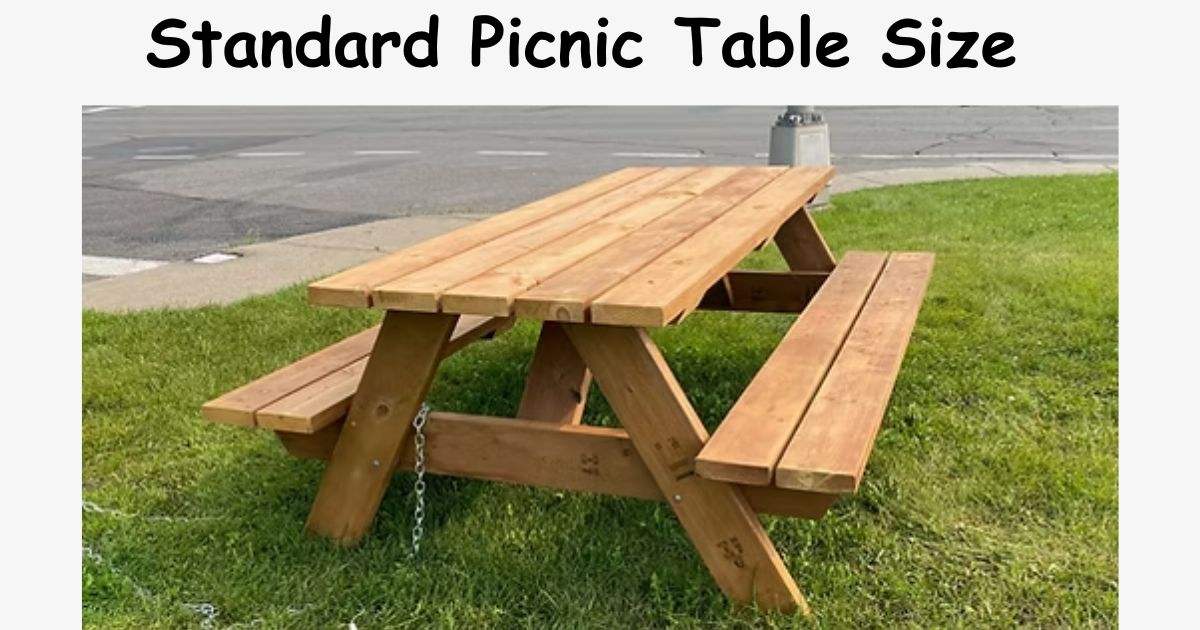
The 6-foot table (72 inches long, 29 inches wide, 30 inches tall) is the backyard workhorse. Six adults sit without touching elbows. It fits on a standard patio, doesn’t require two people to move, and works equally well on concrete, grass, or gravel. In centimeters: 183 cm long, 74 cm wide, 76 cm tall. In meters: roughly 1.83 x 0.74 x 0.76.
The 8-foot table (96 inches long, 28–30 inches wide, 29–30 inches tall) is what parks and campgrounds use. It seats 8, handles crowds, and typically weighs significantly more — some park models hit 300 pounds. That weight isn’t a flaw; it keeps them anchored. But at home, moving one for winter storage or a backyard project becomes a whole event. In centimeters: 244 cm long, 71–76 cm wide, 76 cm tall. In meters: 2.44 x 0.76 x 0.76.
Neither is universally better. The right one depends on how much space you have and how many people you’re feeding.
Other Sizes Worth Knowing
Kids’ tables shrink the whole frame down. Usually 48 inches long (4 feet), 24 inches wide, and 20 to 24 inches tall. Bench height drops to around 12 inches. Built for kids up to about age 10. A 30-inch adult table puts the surface at a young child’s chest — they end up standing or kneeling the whole time, which isn’t comfortable for anyone.
Round tables run 46 to 60 inches in diameter and seat 4 to 6 people. No awkward end seats. Everyone faces each other, which makes them great for small groups or conversations that actually go somewhere. They take up more floor space per person than a rectangular table, so they work better on open patios than tight decks.
ADA-accessible models are wider by design — typically 96 inches total, with a 60-inch tabletop and 18-inch access aisles built in on at least one side. Knee clearance underneath is a minimum of 27 inches. If you’re outfitting a shared outdoor space, this isn’t optional — it’s just thoughtful planning.
Quick Size Reference
| Type | Length | Width | Table H | Bench H | Seats |
| 6-ft Standard | 72 in / 183 cm | 29 in / 74 cm | 30 in / 76 cm | 17–18 in / 43–46 cm | 6 |
| 8-ft Standard | 96 in / 244 cm | 28–30 in / 71–76 cm | 29–30 in / 76 cm | 17–18 in / 43–46 cm | 8 |
| Kids (4-ft) | 48 in / 122 cm | 24 in / 61 cm | 20–24 in / 51–61 cm | 12 in / 30 cm | 4–6 |
| Round | 46–60 in dia. | — | 28–30 in / 71–76 cm | 17 in / 43 cm | 4–6 |
| ADA Accessible | 96 in total | 60 in / 152 cm | 30 in / 76 cm | 17–18 in (one side) | 6 + wheelchair |
Read also: Cornhole Board Dimensions: Complete Guide to Regulation Size, Hole Placement & DIY Build
The Space Around the Table (Most People Skip This Part)
Buying the table is step one. Figuring out where it actually lives — that’s where people make expensive mistakes.
A 6-foot table needs roughly 10 x 12 feet of total space. That includes 2 feet of clearance behind each bench so people can sit down and stand up without crawling. An 8-foot table pushes that to 12 x 14 feet.
On uneven ground, add another 2 to 3 feet of buffer so the legs can be leveled properly without the table overhanging an edge.
For events: two 6-foot tables placed 5 feet apart handles 12 people with room to move. Six 6-foot tables arranged in a U-shape seats 36 people and leaves enough aisle space that servers or guests can walk through without turning sideways.
Sketch it before you buy it. Even a rough outline on paper catches problems that photos and product listings never show.
Tablecloths: Getting the Size Right
This is where the math trips people up. You measure the table, buy that size cloth, and end up with something that barely covers the top. No drop, no coverage on the sides, looks like a napkin.
For a 6-foot table (72 x 29 inches), go with 60 x 120 inches — that’s 152 x 305 cm. It gives about 12 inches of drop on the long sides and 15 on the short ends.
For an 8-foot table (96 x 29 inches), you want 60 x 144 inches — 152 x 366 cm.
Anything under 10 inches of drop looks off. It’s one of those details that’s obvious once you notice it. Aim for at least 12 inches on all sides if you care about how it looks.
If You’re Building One
A 6-foot A-frame is the most common DIY picnic table build, and it’s genuinely beginner-friendly. The cut list is straightforward:
Tabletop boards: five or six 2×6 planks cut to 72 inches.
Bench boards: 2x10s cut to 72 inches, 12 inches wide.
Legs: 2x4s cut at a 30-degree angle. Cross braces: 2x4s cut to 29 inches.
Total lumber: roughly eight 8-foot 2×6 boards and four 8-foot 2x4s. Tools needed are basic — a circular saw, a drill, and exterior-grade screws.
The 30-degree leg angle isn’t decorative. It’s structural. Angled legs handle soft or uneven ground without rocking. A flat-legged table looks fine in a showroom and wobbles on every lawn.
To scale to 8 feet, extend every horizontal cut by 24 inches. Everything else stays the same.
How Material Affects the Numbers
Wood — cedar or pine — sticks closely to standard dimensions because lumber comes in standard sizes. A 2×6 plank is a 2×6 plank. Expect some weight. Expect annual sealing if you want it to last.
Metal frames can go slimmer — some as narrow as 24 inches wide — which works well in tighter spaces. Steel holds up outdoors without warping and a well-built version can last decades. Heavier gauge steel also adds a couple of inches to overall height, worth checking if you’re placing it under a pergola or covered porch with a low ceiling.
Plastic (usually HDPE) matches wood dimensions almost exactly but weighs dramatically less — sometimes 100 pounds less on an 8-foot model. It won’t rot, doesn’t need sealing, and you can actually move it without calling a neighbor.
Read also: Baby Grand Piano Dimensions: Sizes, Weights & Room Requirements Explained
Things That Catch People Off Guard
Legroom is the most overlooked number. Ten inches between the bench and the tabletop underside is the floor. Twelve is comfortable. Some cheaper tables cut this down to 8 inches to make the profile look sleaner. You feel it the moment you sit down. Always check this before buying — it won’t be on the main product photo.
Kids can’t comfortably use adult tables. Not safely, not enjoyably. The height difference is significant enough that they spend the whole meal propped awkwardly. A kids’ table isn’t a luxury purchase — it’s just the right tool.
Heavy tables aren’t always better for home use. A 300-pound park table is durable and stable. It’s also immovable. If you need to store it seasonally, refinish a deck, or simply rearrange your outdoor space, that weight becomes a real problem. For home use, weight is a tradeoff — not automatically a feature.
Bench weight rating. Standard tables hold around 400 pounds per bench. That’s fine for typical home use. For commercial or school settings, check the spec sheet — not all tables are built the same.
Straight Answers to Common Questions
What’s the standard picnic table size in inches?
A 6-foot table: 72 inches long, 29 inches wide, 30 inches tall. An 8-foot table: 96 inches long, 28–30 inches wide, 29–30 inches tall.
What size tablecloth fits a 6-foot picnic table?
60 x 120 inches. That’s the size that covers it properly with enough drop to look right.
How many people does a standard picnic table seat?
Six for a 6-foot table, eight for an 8-foot. That’s based on about 24 inches of bench space per person.
Is 6-foot or 8-foot better for a backyard?
Six feet for most backyards. It’s easier to move, fits more spaces, and seats a family comfortably. Eight feet makes sense if you regularly host larger groups and have the space to support it.
What are picnic table dimensions in meters?
A 6-foot table: 1.83 m x 0.74 m x 0.76 m. An 8-foot table: 2.44 m x 0.76 m x 0.76 m.
The One Thing That Settles Most Decisions
Measure your actual outdoor space first — not just the table footprint but the full area including the clearance behind each bench. Most buying mistakes happen because people measure the table, not the space the table needs to function.
Get that number right and the rest falls into place. Six feet or eight feet, wood or plastic, round or rectangular — those are style decisions. Space is the one that determines whether the table works at all.

I am the editor and author of StoriesRadius.com, a blog about measurements and dimensions. I enjoy turning numbers and sizes into simple stories that anyone can understand. From everyday objects to curious facts, I share clear guides based on real research and experience. My goal is to make learning about length, height, and size fun, useful, and easy for all readers.