You’re standing in the office supply aisle holding two nearly identical yellow boxes. Both say “staples.” One says 26/6. The other says 24/8. You have no idea what either means, and the person next to you looks just as confused.
Here’s the thing — you don’t need to memorize a catalog. You just need to understand one simple idea, and the rest takes care of itself.
The Number Code Is Simpler Than It Looks
Every staple box shows two numbers separated by a slash. That’s it. That’s the whole system.
The first number is the wire gauge — how thick the metal is. The second number is the leg length in millimeters — how far the prong pokes through your paper stack.
The part that confuses almost everyone: a lower gauge number means thicker wire. So 23-gauge wire is stronger and heavier than 26-gauge. It sounds backwards, but that’s how wire gauges work.
Quick example. A 26/6 staple has thin wire and short 6mm legs. A 23/13 has thick wire and 13mm legs. One is for light everyday paper. The other is for a 90-page report.
That’s the whole code cracked.
What People Are Actually Trying to Figure Out
Search patterns around staple sizes fall into a few honest situations:
Someone’s stapler keeps jamming and they suspect the staples are wrong. Someone’s binding a thick document and the staple bends instead of going through cleanly. Someone bought a new stapler and has no idea what fits it. Someone is doing upholstery, landscaping, or roofing and discovered that “staples” apparently means something completely different outside an office.
Each situation has a different fix, so let’s go through what actually matters for each one.
Office Staple Sizes
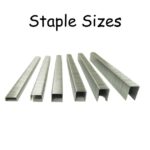
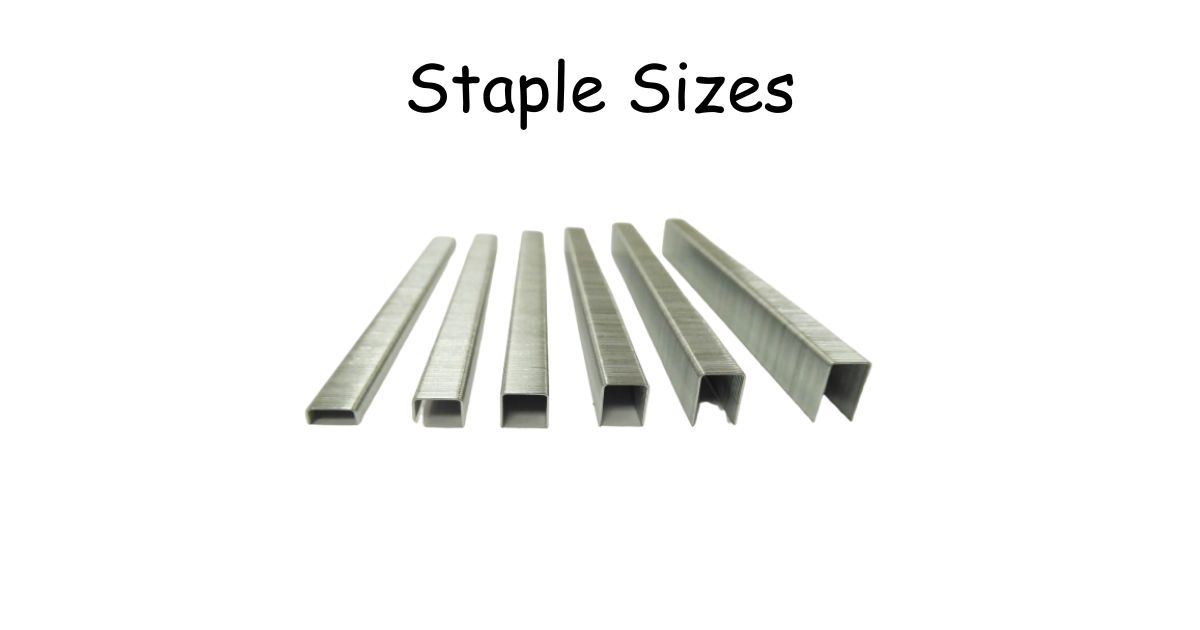
For paper-based tasks, four sizes cover almost every situation you’ll face.
26/6 is the default. Thin 0.45mm wire, 6mm legs. Works on 15–25 sheets. Fits the vast majority of basic desktop staplers in homes and offices.
24/6 has slightly thicker 0.50mm wire, same leg length. A bit more grip on the same sheet count. European brand staplers — Rapid especially — tend to prefer this one. Rexel machines often use a 56-series label for essentially the same thing.
26/8 keeps the thinner wire but adds 2mm of leg length, which pushes capacity to around 35–40 sheets. This is the right pick for school assignments and folders.
24/8 is the workhorse for mid-level office use. Thicker wire plus the longer leg handles 40–50 sheets without bending or riding up on the edges.
| Size | Wire Thickness | Leg Length | Sheet Capacity |
| 26/6 | 0.45mm | 6mm / ¼” | 15–25 sheets |
| 24/6 | 0.50mm | 6mm / ¼” | 20–30 sheets |
| 26/8 | 0.45mm | 8mm / 5/16″ | 30–40 sheets |
| 24/8 | 0.50mm | 8mm / 5/16″ | 40–50 sheets |
Mini staplers — the pocket-sized ones — take No. 10 or 13/6 staples. These are physically narrower. Standard 26/6 won’t even load into them correctly.
Read Also: Flashcard Sizes: The Practical Guide Nobody Actually Writes
When You’re Stapling More Than 50 Sheets
This is where the 23-series takes over. The wire is 0.60mm thick — noticeably stiffer. It won’t buckle on thick stacks the way thin office wire does.
But there’s a catch: 23-series staples need a heavy-duty stapler to drive them. Don’t try loading these into a regular desktop model. The mechanism doesn’t have enough force, and you’ll jam it immediately.
| Size | Leg Length | Capacity | Best Fit |
| 23/8 | 8mm / 5/16″ | 40–50 sheets | Thick reports |
| 23/10 | 10mm / 3/8″ | 60–70 sheets | Proposals, manuals |
| 23/13 | 13mm / ½” | 90–100 sheets | Bulk binding |
| 23/20 | 20mm / ¾” | 150–200 sheets | High-volume stacks |
Practical reality check: stapling a 60-page client proposal with 26/6 staples will fail. The legs are too short. The wire buckles. You end up with a bent scrap of metal half-buried in the cover page. A 23/10 drives straight through and folds flat every time.
Sizes for Fabric, Wood, and Outdoor Use
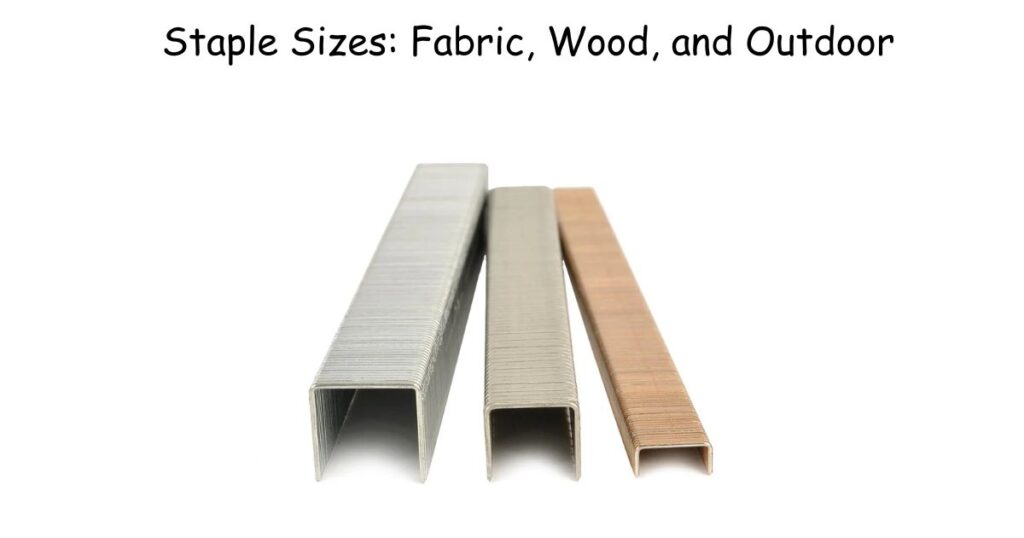
Once you leave paper behind, the sizing language changes completely.
Upholstery
Upholstery staples are described by crown width and gauge, not the office slash notation. Narrow-crown staples (3/8 inch wide) are used for most fabric work — light cushions take 20-gauge, heavy vinyl or leather needs 16-gauge. The narrow crown sits flush under fabric without creating visible lumps.
Medium-crown staples (roughly ½ to 15/16 inch) handle cabinet work and subflooring. Wide-crown staples (1 inch or more) are used in roofing, sheathing, and insulation — the wide top spreads pressure over a larger surface area so material doesn’t tear away.
Landscape and Outdoor
Landscape staples are U-shaped metal pins, not the flat kind at all. They’re 6–12 inches long, made from thick 8–11 gauge wire, and used to pin down sod, weed fabric, or erosion control matting into soil. The size you need depends on how deep your ground cover is and how much pull the weather creates against it.
Booklet Making
Saddle-stitch booklet makers use a centered fine-wire staple — the 66/6 is standard for zines and pamphlets. These staples go through the spine fold rather than through a flat stack, so the design is completely different from anything in an office drawer.
mm to Inches, Translated Simply
Staple boxes in the US often show millimeters even though most buyers think in inches. Here’s a direct conversion to save the mental math:
- 6mm = ¼ inch
- 8mm = just under 5/16 inch
- 10mm = just under 3/8 inch
- 13mm = just about ½ inch
- 20mm = just under ¾ inch
So when someone asks about 26/6 staples size in mm — that’s 0.45mm wire diameter, 6mm leg. And 24/6 in mm is 0.50mm wire, 6mm leg. Same leg, different wire strength.
Why Jams Happen (It’s Usually the Size)
Most staple jams aren’t mechanical failures. They’re size problems wearing a mechanical disguise.
Short legs on a thick stack can’t clear the paper and fold underneath — the staple just crumples inside the throat. Thin wire on a heavy stack buckles before it exits. Even a correctly sized staple from the wrong brand can jam if the crown is fractionally wider than what the stapler’s channel was built for.
The fix: flip your stapler upside down. The compatible sizes are almost always printed on the base. That label is your starting point, not the box that looks close enough.
One more thing most people skip — straighten your stack before you staple. Paper fanned unevenly at the corner puts the staple in at an angle, and the leg on one side has to travel further than the other. That’s all it takes to split a staple clean in half.
Things Worth Knowing Before You Buy
Not every “standard” staple is the same standard. The US default is 26/6. European staplers often default to 24/6. They look the same in the box, but loading the wrong one into a stapler built for the other causes repeated misfires that feel like a broken machine.
Don’t buy in bulk before you test. A box of 5,000 wrong-gauge staples is an expensive lesson. Buy a small pack, run 10–15 staples through your specific machine, and then stock up.
Glossy paper and heavy cardstock are denser than regular copy paper. If you’re stapling 20 sheets of photo paper, treat it like 30 sheets of regular paper when picking leg length.
Read Also: GoodNotes Paper Size: Which One Should You Actually Use?
Straight Answers to Common Questions
What size staple does a standard stapler take?
Usually 26/6 or 24/6. Check the bottom of your stapler first — it’s printed there.
Can heavy-duty staples fit a regular stapler?
No. The staple will physically load, but the machine can’t drive it. You’ll jam on the first click.
What size do I need for 100 pages?
23/13 handles up to 100 sheets. For more than that, use 23/20 or consider spiral binding.
Is 26/6 or 24/6 better?
For under 20 sheets, no practical difference. For 25–30 sheets, 24/6 holds more firmly because the thicker wire grips better through the stack.
Where can I find a staple size chart PDF?
Rapid and Senco both publish compatibility charts. Search “staple compatibility chart PDF” and their official sites come up quickly.
The One Thing That Decides Everything
People get caught up in brands, gauge numbers, and packaging. But the real variable — the one that causes almost every problem — is leg length versus stack thickness.
Get the leg length right for your actual page count and you’ve solved 90% of potential issues. Everything else is secondary.
Check your stapler’s base for the compatible size, match the leg length to your stack, and don’t load industrial staples into a machine that wasn’t built for them. That’s genuinely all you need to walk away with from this.

I am the editor and author of StoriesRadius.com, a blog about measurements and dimensions. I enjoy turning numbers and sizes into simple stories that anyone can understand. From everyday objects to curious facts, I share clear guides based on real research and experience. My goal is to make learning about length, height, and size fun, useful, and easy for all readers.