You measured your backyard. You sketched a rough layout. You drove to the lumber yard feeling pretty prepared — and then someone handed you a board labeled “5/4 x 6” that doesn’t measure 1.25 inches by 6 inches anywhere on its body.
That’s where most people hit a wall.
The sizing system for lumber is genuinely confusing the first time you encounter it. Not because it’s complicated — it’s actually pretty logical once someone explains it — but because nobody warns you upfront that the numbers on the tag and the numbers on the tape measure are two different things.
The Label Is Not the Real Size
Lumber gets its name from rough measurements taken before the board is dried and smoothed. Once it goes through that process, it comes out smaller. That’s just how wood works.
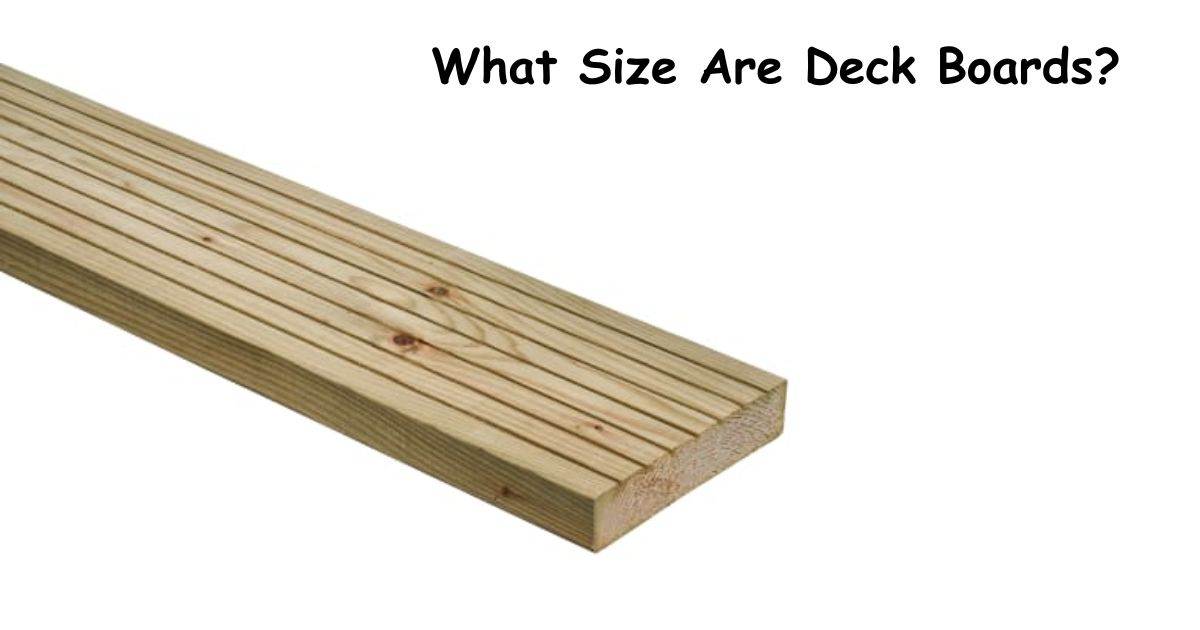
So a “5/4 x 6” board — the most common deck board you’ll find anywhere — actually measures about 1 inch thick by 5.5 inches wide when you put a tape to it.
A “2×6” isn’t 2 inches by 6 inches. It’s 1.5 inches by 5.5 inches.
The labeled size is called the nominal size. The real, measurable size is called the actual size. Use the actual size for every calculation you do. If you plan around the nominal size, you’ll either run short on boards or end up with gaps you didn’t account for.
The Sizes You’ll Actually See at the Lumber Yard
Most deck projects use one of five board profiles. Here’s what they look like in real life:
| Nominal Size | Actual Measurement | Works Best When |
| 5/4 x 6 | 1″ thick × 5.5″ wide | Joists 16″ apart — typical backyard deck |
| 2 x 6 | 1.5″ thick × 5.5″ wide | Joists 24″ apart or elevated deck |
| 1 x 6 | 0.75″ thick × 5.5″ wide | Light-traffic porches, ground-level builds |
| 1 x 4 | 0.75″ thick × 3.5″ wide | Borders, stair details, accent strips |
| 2 x 8 | 1.5″ thick × 7.25″ wide | Wide-plank look, premium builds |
The 5/4 x 6 is what most people buy, and for good reason. It’s the right thickness for standard framing, it covers ground quickly, and it feels solid when you walk on it. If you’re building a basic backyard deck, this is your board.
The 2×6 steps in when the deck is raised off the ground or the joists are spaced wider. It has more thickness, which means less bounce underfoot. Worth the extra cost on any elevated build.
The 1×4 isn’t really a surface board. It’s a detail board — think clean border edges, picture-frame perimeters, or stair risers.
Lengths: What’s Available and What Makes Sense
Boards come in 8, 10, 12, 16, and 20-foot lengths. Most home decks are served well by 12-foot boards. They span a typical deck width without a seam, which means fewer cuts and a cleaner surface.
Go longer only if your deck genuinely needs it. A 20-foot board sounds efficient, but it’s heavy, harder to maneuver alone, and requires perfectly straight framing to look right once it’s down.
For decks wider than 12 feet, you’ll need to join boards over a joist. When that happens, don’t let all your seams land in the same row. Stagger them across different joists — it looks intentional and the deck is structurally tighter.
Metric Measurements (For International Sourcing or Planning)
If you’re working in metric or ordering from an overseas supplier, here’s how standard boards translate:
- 5/4 x 6 → approximately 25mm thick × 140mm wide
- 2 x 6 → approximately 38mm thick × 140mm wide
- 1 x 4 → approximately 19mm thick × 90mm wide
- Lengths run from 2.4m to 6m
Keep in mind that metric regions sometimes stock 90mm, 120mm, or 140mm widths as their standard. Confirm what’s actually available locally before planning around a specific width.
Read also: Fat Quarter Dimensions: Exact Sizes in Inches, CM & Meters Explained
How Board Width Affects the Look of Your Deck
Width is as much a design decision as a structural one.
Narrow boards — 3.5 inches — make a deck feel refined. They work especially well on curved or angled layouts because they bend and fit more easily. They also disguise minor framing irregularities better than wide boards do.
Standard 5.5-inch boards are the workhorse. Flat rectangular decks, straightforward layouts, most homes. Nothing wrong with them visually either — they look clean and balanced.
Wide boards at 7.25 inches feel modern and open. Fewer seams, less visual busyness. The trade-off is that wide boards are more likely to cup when they get wet. Install them crown-side up — meaning the slight arch faces upward — so water runs toward the edges instead of collecting in the center.
Gaps Between Boards: Small Detail, Big Consequence
Get this wrong and the deck will show it within a season.
Freshly cut pressure-treated lumber holds a lot of moisture. It will shrink as it dries out. Install those boards too close together and they’ll eventually warp against each other. Leave about 1/8 inch between wet boards — a standard 16-penny nail laid flat makes a reliable spacer.
Dry or kiln-dried boards have already done most of their shrinking. Give those 3/16 inch of breathing room.
Composite and PVC boards don’t shrink the way wood does. They still need a gap — about 1/16 to 1/8 inch — but mostly to allow for minor temperature expansion rather than moisture changes.
Uneven spacing leads to a wavy surface. It’s the kind of thing that’s obvious from 20 feet away. Use actual spacers, not eyeballing.
Wood vs. Composite: Same Shape, Different Behavior
Composite boards are designed to match wood profiles, so the dimensions are the same. A composite 5/4 x 6 still measures about 1 inch by 5.5 inches. You don’t need to reframe anything or recalculate board counts.
What does change is how they behave over time. Composite holds its size through seasons. No significant shrinking, no cupping from rain, no annual sanding. The trade-off is higher upfront cost and a surface that some people feel looks less natural.
PVC boards are even more dimensionally stable. They work well for stair treads where a slim, clean edge matters more than a natural grain look.
One practical note: composite often comes in more width options — 3.5-inch and 7.25-inch versions are easier to find in composite than in solid wood. If you want a wide-plank look without fighting warped lumber, composite makes it easier.
Planning Your Deck Size Around Real Use
This is where a lot of people underplan.
A 10×10 foot deck looks spacious on paper. In reality, once you put four chairs and a small table on it, there’s no comfortable room to walk around. People bump into furniture. Nobody relaxes.
Here’s a more grounded way to think about it:
A standard 6-person outdoor dining table takes up roughly 3 feet by 6 feet of floor space. Pull the chairs out, add someone walking behind a seated guest, and that scene needs closer to 10 feet by 12 feet just to function without feeling cramped.
For a proper entertaining deck — table, chairs, a grill zone, and actual walkable space — 200 square feet is a reasonable minimum. Something like 12×16 or 14×14 feet.
If you’re adding a separate lounge area with a sofa and chairs, that’s a second functional zone. Budget another 8×10 feet at minimum.
Small decks get avoided. People use the yard or the living room instead. It’s worth sizing up if you’re already building.
Read also: Cornhole Board Dimensions: Complete Guide to Regulation Size, Hole Placement & DIY Build
How Many Boards Does Your Deck Actually Need?
Here’s a practical estimate using standard 5.5-inch boards with 1/8-inch gaps:
| Deck Size | Boards Needed | Rough Board Cost (wood) |
| 10 × 10 ft | ~22 boards | $70–$110 |
| 12 × 16 ft | ~42 boards | $130–$210 |
| 20 × 20 ft | ~88 boards | $270–$440 |
These figures are for pressure-treated pine at roughly $3–5 per board. Cedar and composite both run higher.
Always add 10–15% for waste. Cuts, rejected boards, mistakes — they add up fast. On a 42-board job, buy 47 or 48. Running short mid-project and finding the lumber yard is out of stock in your exact length is a real and avoidable problem.
If you switch to 7.25-inch wide boards, you’ll need roughly 20% fewer boards overall. That’s a meaningful difference on a large deck — both in material cost and in the number of fasteners and cuts.
What People Get Wrong When They Shop
They pick boards without inspecting them. The cheapest board in the pile is usually the wettest, the most twisted, or the most knotted. Pull boards out. Sight down the edge like a rifle to check for warp. Reject anything that bows significantly or feels noticeably heavier than the others — that extra weight is moisture that will cause shrinking and movement later.
They forget that fresh lumber shrinks. Pressure-treated lumber straight off the truck is wet. It will change shape as it dries in your yard. Buy pre-dried when possible. If you can’t, stack the boards flat with spacers between them for a few days before installing — this lets air move through and reduces warping after they’re fastened down.
They install crown-side down. Every board has a slight arc to it. You want that arc facing up. If it faces down, the board creates a valley that collects water. Crown up, water rolls off.
Questions People Actually Ask
Does joist spacing really matter for board thickness?
Yes, it does. A 1-inch thick 5/4 x 6 board on 16-inch joist spacing feels solid. That same board on 24-inch spacing will flex noticeably underfoot — not dangerous, but uncomfortable. Move to a 2×6 (1.5 inches thick) when your framing is wider spaced.
Can I mix different board widths on the same deck?
Absolutely. A common approach is to use narrow 3.5-inch boards as a picture frame around the perimeter and fill the center field with standard 5.5-inch boards. It looks deliberate and adds a finished quality without extra structural work.
What if I want a diagonal pattern?
Diagonal layouts look great and hide the joist lines underneath. The catch is that diagonal runs cross joists at an angle, which means your boards need to be longer to cover the same surface area — usually 15–20% more material. Also, narrow boards handle diagonal patterns better than wide ones.
Does cedar need different spacing than pressure-treated pine?
Cedar has natural oils that resist moisture, which means it doesn’t shrink and expand as dramatically as pressure-treated pine. That said, give it the same 3/16-inch gap you’d give dry pine. Cedar also splits easily at the ends, so pre-drill before driving screws — especially within 3 inches of a board end.
The One Thing Worth Focusing On
People spend a lot of energy comparing wood species and debating composite versus natural. That stuff matters, but it matters less than getting your measurements right from the start.
Use actual dimensions, not nominal ones. Plan your board count on real widths. Leave proper gaps. Buy a few extra boards.
Those four habits account for most of what separates a deck that looks sharp and stays flat from one that needs attention every spring. The materials you choose are secondary to understanding how those materials actually measure and behave.
Start with that, and the rest of the decisions get a lot easier.

I am the editor and author of StoriesRadius.com, a blog about measurements and dimensions. I enjoy turning numbers and sizes into simple stories that anyone can understand. From everyday objects to curious facts, I share clear guides based on real research and experience. My goal is to make learning about length, height, and size fun, useful, and easy for all readers.