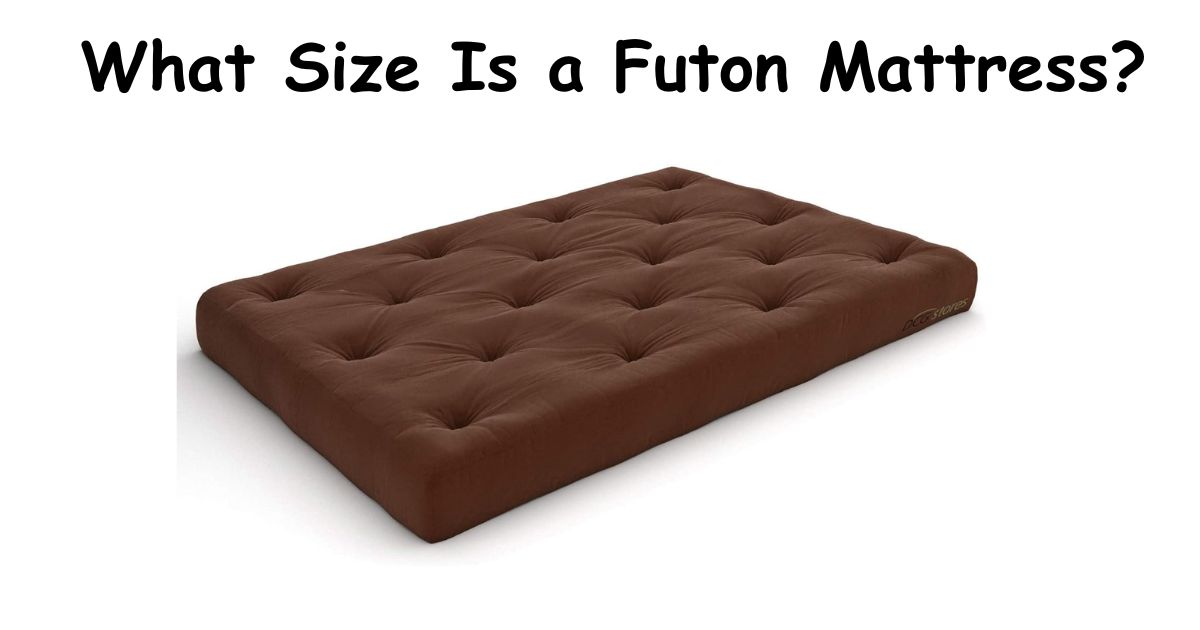
You measured the wall. You picked the frame style. Then someone asked, “But what size mattress do you need?” — and suddenly you’re not sure.
It feels like it should be obvious. It’s not always.
Futon mattress sizes follow the same names as regular bed sizes — twin, full, queen. But the dimensions aren’t the only thing to match. Thickness, frame type, fold style, room layout — they all connect. Get one wrong and you’ve either bought a mattress that doesn’t fit the frame or one that’s too stiff to fold into a couch.
Here’s what actually matters.
The Sizes, Laid Out Simply
Futon mattresses come in standard widths and lengths that mirror regular bed dimensions. So if you already know that a full-size bed is 54 inches wide, a full futon mattress is the same.
| Size | Width x Length (inches) | Width x Length (cm) |
| Twin | 39 x 75 | 99 x 191 |
| Twin XL | 39 x 80 | 99 x 203 |
| Full | 54 x 75 | 137 x 191 |
| Full XL | 54 x 80 | 137 x 203 |
| Queen | 60 x 80 | 152 x 203 |
| King | 76 x 80 | 193 x 203 |
A few things worth noting right away:
Twin is narrow — 39 inches. That’s fine for a child or a college dorm, but an adult who moves around in sleep will feel cramped fast. Full at 54 inches is the most common choice people land on. It’s wide enough to sleep one adult comfortably, and it doesn’t dominate a room. Queen at 60 x 80 inches is where you go when two people are sleeping on it with any regularity.
King futons exist on paper. In practice, they’re rare. Most standard apartment doorways and rooms don’t cooperate with a 76-inch-wide folding piece of furniture.
Who’s Actually Shopping for This — and What They Need
The apartment person has a studio or one-bedroom and needs something that functions as both couch and bed. They’re not just buying a mattress — they’re figuring out whether the whole setup will work in a space that’s maybe 400 square feet. For them, size isn’t just about sleeping comfort. It’s about whether the thing fits through the door and doesn’t eat the entire living room.
The guest room buyer wants something decent for visitors a few times a year. They’re probably leaning toward full because it seems like enough. It usually is — for occasional use, a full futon handles one or two guests without any drama.
The replacement shopper already has a frame. The mattress is worn out. They just need to know if futon sizes match regular mattress sizes (they do) and whether they can grab a standard full or queen mattress. The answer is mostly yes — with one catch covered below under frame compatibility.
The parent is setting up a room for a kid or teenager. Twin makes sense size-wise and price-wise. The question is really about durability and whether it’ll last more than two years of daily use.
Read also: Twin Size Blanket Dimensions: The Numbers That Actually Matter
Full Size Futon — What You’re Actually Getting
The full futon mattress is 54 inches wide and 75 inches long. In a room, that’s manageable. Open flat as a bed, it needs roughly a 7 x 9-foot clear space. Folded as a sofa, the frame sits around 54 inches wide, 25 inches deep, and about 30–35 inches tall.
One adult sleeps on it without issue. Two adults technically fit, but 54 inches split two ways is 27 inches each — barely wider than a single cot per person. It works for a night or two. Not comfortable as a long-term arrangement.
A full frame typically holds between 400 and 600 pounds and folds once down the middle (bi-fold) or into thirds (tri-fold). Bi-fold is the standard. Tri-fold works better in really tight spaces because it stacks the mattress more compactly when folded.
When shopping for sheets: a full futon uses full-size fitted sheets, but you’ll want deep-pocket ones — at least 12 inches of pocket depth — because most futon mattresses are bulkier than a thin conventional mattress.
Queen Size Futon — When the Full Just Isn’t Enough
Queen measures 60 x 80 inches. That extra 6 inches of width changes the sleeping experience noticeably for two people. And the length — 80 inches versus 75 — matters if anyone sleeping on it is close to or over six feet tall.
The tradeoff: a queen needs more room. You’re looking at about 8 x 10 feet of open floor space when it’s flat. The frame is heavier, harder to move, and needs more wall clearance behind it to fold back properly. Weight capacity on a solid queen frame goes up to around 800 pounds.
If the room is tight, go full. If two people are sleeping on it regularly and space allows, go queen. That’s really the whole decision.
Thickness — The Part Most People Underestimate
This is where a lot of buyers quietly make a mistake.
Futon mattresses range from 4 inches to 12 inches thick. That’s not a small range — that’s the difference between sleeping on something that feels like a firm camping pad and something that feels like a real bed.
4 to 6 inches works for kids, rarely-used guest setups, or people who genuinely don’t mind a firmer surface. It folds easily. It’s cheaper. But daily adult use on a 4-inch mattress leads to sore backs within weeks.
6 to 8 inches is the practical middle ground. It folds without too much resistance, still functions as a couch cushion, and provides decent sleep support for occasional use.
8 inches and above is what you want if this futon is your primary bed. It mimics the feel of a real mattress. The tradeoff is that thicker mattresses resist folding — a 10-inch memory foam futon may not sit cleanly in sofa position or might look stiff and bunched.
Pick thickness based on what the futon is used for most. If it’s mostly a sofa that turns into a bed a few times a month, 6–7 inches is fine. If someone’s sleeping on it every night, start at 8.
Materials and How They Affect Both Sitting and Sleeping
The fill changes everything about how a futon feels in both positions — and sofa-feel and sleep-feel don’t always point to the same material.
Cotton only — thin, folds easily, very firm. Good for people who want a minimal, traditional feel. Compresses over time and needs rotating often.
Cotton-foam blend — the most widely used option. Medium firmness, folds without much trouble, and doesn’t bottom out under a seated person. Reliable for everyday dual use.
Memory foam — contours well for sleeping. But seated, it tends to let you sink in a way that doesn’t feel supportive. If going memory foam, pick a higher-density version. Softer memory foam feels great flat but turns mushy as a couch.
Latex — snaps back quickly, which helps with both sitting and sleeping. Resists allergens. More expensive, but it holds up longer than foam blends.
Coil or hybrid — best if the futon is used almost exclusively as a bed and rarely folds. Repeated folding can gradually shift or damage the coil structure. Innerspring-only futons aren’t worth considering — they’re too rigid and don’t fold cleanly.
Read also: King Size Pillow Dimensions: The Real Answer You’re Looking For
Frame Fit — Measure Before You Order
Here’s the thing: futon mattress sizes match standard bed sizes, but frames vary slightly between manufacturers. Some twin frames measure 38 inches wide instead of 39. Some full frames run a touch shorter than 75 inches.
If you’re buying a replacement mattress for an existing frame, don’t just order by size name. Measure the deck — the flat surface area the mattress actually rests on. For a full frame, the back deck should measure between 72 and 75 inches. That tells you whether a standard full mattress will sit flush or leave a gap.
Frame type also matters for mattress choice. Bi-fold frames work well with full and queen mattresses for daily folding. Tri-fold frames suit twin sizes and tight spaces where the folded sofa needs to be as compact as possible.
A Few Things People Get Wrong
Buying the mattress before measuring the frame deck. The listed frame size and the actual sleeping surface aren’t always identical.
Picking a full for two people because “it’s probably fine.” It’s fine for guests. It’s not fine for a couple sleeping on it every night.
Ignoring fold behavior when buying thick mattresses. A beautiful 10-inch latex futon that won’t fold flat defeats the purpose of having a futon.
Forgetting that deep-pocket sheets are non-negotiable. Standard fitted sheets slide off futon mattresses constantly. Futon-specific zippered covers solve this entirely.
How Long It’ll Last — and How to Get More Out of It
A quality frame holds up for 10 years or more. The mattress is a different story — plan to replace it every 5 to 7 years with daily use.
Rotate it every three months. The fold points take the most stress, so rotating redistributes wear across the whole surface. Air it out once a week if possible — foam traps moisture, especially in humid rooms.
If the futon is being used primarily as a bed, unfold it flat at night rather than leaving it half-folded. Constant fold pressure breaks down the seam areas faster than anything else.
Real Questions, Direct Answers
Can a futon replace a regular bed?
Yes — if you pick 8+ inches of thickness and a quality fill like latex or a cotton-foam blend. A 4-inch futon mattress is not a bed replacement, regardless of what the price tag implies.
Do regular mattress sheets fit a futon?
By size, yes. Twin sheets fit a twin futon, full sheets fit a full futon. Just get deep-pocket versions — 12 inches minimum — or a zippered futon cover.
What does “full double futon” mean?
Same thing. Full and double are interchangeable terms for the same size: 54 x 75 inches. Different brands use different names.
Is a twin futon too small for an adult?
For sleeping, it’s usable but tight — 39 inches wide doesn’t leave much room to move. For a child or a teen, it’s completely fine.
Should I measure in cm instead of inches?
If you’re ordering internationally or your space is measured metrically: full is 137 x 191 cm, queen is 152 x 203 cm, twin is 99 x 191 cm.
The Short Version If You’re in a Hurry
Solo adult in a smaller space — go full, 6 to 8 inches thick, cotton-foam blend.
Two people sleeping on it regularly — go queen, 8+ inches, latex or dense cotton-foam blend.
Kid’s room or tight space — go twin, 6 inches is plenty, cotton or cotton-foam.
Measure your frame deck before ordering a replacement. Check that deep-pocket sheets are in your cart. And don’t let a low price talk you into 4 inches of thickness if your back matters to you.
That’s the whole decision, honestly. Nothing here needs to be complicated.

I am the editor and author of StoriesRadius.com, a blog about measurements and dimensions. I enjoy turning numbers and sizes into simple stories that anyone can understand. From everyday objects to curious facts, I share clear guides based on real research and experience. My goal is to make learning about length, height, and size fun, useful, and easy for all readers.